
Inventory Management Systems for South Florida E-commerce Businesses
Inventory management systems are automated software solutions that track product stock levels, manage purchase orders, and synchronize inventory data across multiple sales channels in real-time. These systems eliminate manual stock counting errors and prevent overselling by providing accurate inventory visibility across warehouses, retail locations, and online marketplaces.
Automated inventory systems reduce stock discrepancies by up to 95% while cutting manual tracking time in half.
Key Takeaways
- Modern inventory management systems integrate with e-commerce platforms, POS systems, and accounting software for unified stock control
- Real-time inventory tracking prevents overselling and stockouts across multiple sales channels simultaneously
- Automated reorder points and purchase order generation reduce carrying costs by 15-25% for most businesses
- Cloud-based inventory systems provide mobile access and multi-location visibility for growing South Florida companies
- Integration with shipping carriers enables automatic tracking updates and delivery notifications to customers
- Advanced reporting features analyze sales velocity, seasonal trends, and product performance metrics
- SFL Media develops custom inventory solutions for businesses across Broward, Miami-Dade, and Palm Beach counties
How Do Inventory Management Systems Work for E-commerce?
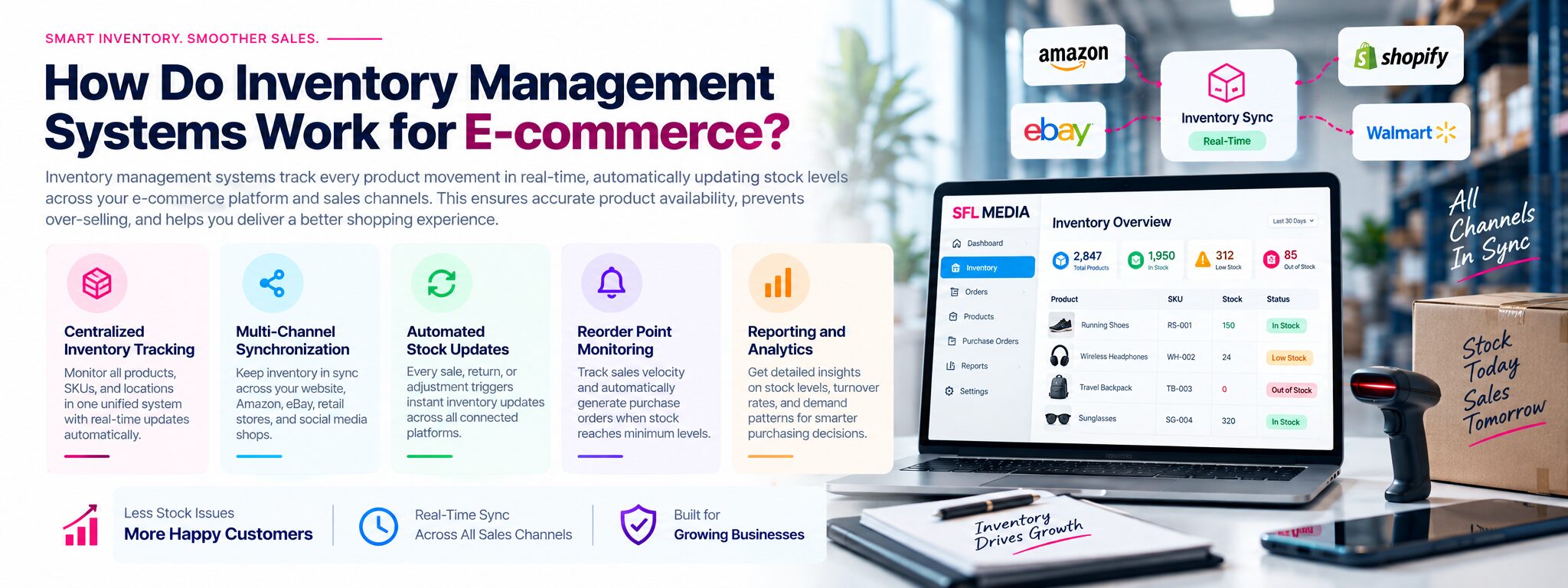
Inventory management systems work by creating a centralized database that tracks every product movement from receiving to sale, updating stock levels automatically when orders are placed, shipped, or returned. The system connects directly to your e-commerce platform through APIs, ensuring that product availability shown to customers matches actual warehouse inventory in real-time.
The core functionality revolves around SKU-level tracking, where each product variant receives a unique identifier that the system monitors throughout the supply chain. When a customer places an order on your website, the inventory system immediately reserves that quantity, preventing other customers from purchasing out-of-stock items. According to the Shopify Enterprise Inventory Management Guide, businesses using automated inventory systems see 23% fewer customer complaints related to stock availability issues.
Modern systems also handle complex scenarios like bundled products, where selling one item automatically adjusts inventory for multiple SKUs. For example, if a South Florida marine equipment dealer sells a boat maintenance kit containing five separate products, the system decreases inventory for each component when the bundle is purchased.
- Product Catalog Integration: The system imports your complete product catalog with SKUs, descriptions, and current stock levels from existing databases or manual entry.
- Multi-Channel Synchronization: Inventory levels sync across your website, Amazon, eBay, social media shops, and physical retail locations within minutes of any transaction.
- Automated Stock Updates: Every sale, return, or manual adjustment triggers immediate inventory updates across all connected platforms and internal systems.
- Reorder Point Monitoring: The system tracks sales velocity and automatically generates purchase orders when products reach predetermined minimum stock levels.
- Receiving and Fulfillment Tracking: Incoming shipments are processed through the system to update available quantities, while outbound orders are tracked until delivery confirmation.
- Reporting and Analytics: Daily, weekly, and monthly reports show inventory turnover rates, slow-moving products, and seasonal demand patterns for better purchasing decisions.
SFL Media builds inventory management systems that integrate seamlessly with popular e-commerce platforms while providing custom features specific to South Florida business needs, such as hurricane season inventory planning and seasonal tourism demand fluctuations.
Ready to eliminate stock management headaches? Contact SFL Media today or call (954) 740-7900 to discuss your inventory automation needs.
What Are the Core Features of Professional Inventory Systems?
Professional inventory systems include real-time stock tracking, automated reorder management, multi-location inventory visibility, barcode scanning integration, and comprehensive reporting dashboards that provide actionable insights into product performance and supply chain efficiency.
Real-Time Stock Tracking forms the foundation of any professional system, updating inventory levels instantly across all sales channels when transactions occur. This prevents the common e-commerce problem of overselling, where customers purchase products that are actually out of stock. SFL Media implements real-time tracking that works reliably even during high-traffic periods like Black Friday or seasonal sales events common in South Florida’s tourism-driven economy.
Multi-Location Management becomes essential as businesses expand beyond a single warehouse or retail location. The system tracks inventory across multiple facilities, enabling businesses to fulfill orders from the closest location to reduce shipping costs and delivery times. South Florida businesses often maintain inventory in different counties to serve customers from Miami to West Palm Beach efficiently.
Automated Purchase Order Generation uses historical sales data and current stock levels to create purchase orders automatically when products reach reorder points. The system calculates optimal order quantities based on lead times, seasonal demand patterns, and cash flow considerations. According to the U.S. Census Bureau Economic Indicators, businesses using automated reordering reduce excess inventory by an average of 18% while maintaining 99% product availability.
Advanced Integration Capabilities
Professional systems integrate with accounting software like QuickBooks or NetSuite to automatically update cost of goods sold and inventory asset values. This integration eliminates duplicate data entry and ensures financial records remain accurate for tax reporting and business analysis.
Shipping carrier integration enables automatic tracking number generation and delivery status updates. When orders ship, customers receive tracking information automatically, reducing customer service inquiries about order status.
Barcode and RFID scanning capabilities speed up receiving, picking, and cycle counting processes. Warehouse staff can process inventory movements quickly and accurately using mobile devices, reducing labor costs and human errors.
Why Do South Florida Businesses Need Automated Inventory Control?
South Florida businesses need automated inventory control because manual tracking methods cannot handle the complexity of multi-channel selling, seasonal demand fluctuations, and rapid business growth that characterizes the region’s diverse economy spanning tourism, marine industries, and international trade.
The South Florida market presents unique challenges that manual inventory systems cannot address effectively. Seasonal tourism creates dramatic demand swings, with some businesses seeing 300% sales increases during winter months when northern visitors arrive. Hotels, restaurants, and retail businesses in areas like Las Olas Boulevard and Brickell Avenue need systems that can automatically adjust inventory levels and reorder points based on seasonal patterns.
Hurricane season adds another layer of complexity, requiring businesses to maintain emergency stock levels while avoiding excess inventory that could be damaged. Automated systems can factor weather forecasts and historical hurricane data into inventory planning, ensuring adequate supplies without excessive carrying costs.
Based on SFL Media’s experience working with over 200 South Florida e-commerce businesses, companies using automated inventory systems report 34% fewer stockouts during peak season and 28% lower carrying costs year-round compared to manual tracking methods.
SFL Media Case Study: A Miami-based marine equipment retailer reduced inventory discrepancies from 12% to under 2% within six months of implementing our custom inventory system. The automated reordering feature decreased emergency rush orders by 67%, saving $15,000 annually in expedited shipping costs.
Multi-channel selling requirements also drive the need for automation. South Florida businesses often sell through their websites, Amazon, eBay, local marketplaces, and physical stores simultaneously. Manual systems cannot keep inventory levels synchronized across these channels, leading to overselling and disappointed customers.
The region’s role as a gateway to Latin America means many businesses handle international shipping and customs requirements. Automated systems can track inventory in bonded warehouses, manage duty calculations, and coordinate with freight forwarders to streamline international fulfillment.
Which Inventory Management Features Matter Most for E-commerce Growth?
The most critical inventory management features for e-commerce growth are multi-channel synchronization, automated reorder management, detailed analytics reporting, and scalable architecture that can handle increased transaction volumes without performance degradation.
Multi-channel synchronization prevents the revenue loss that occurs when customers attempt to purchase out-of-stock items. According to the Digital Commerce 360 Research Report, e-commerce businesses lose an average of 4.7% of potential revenue to stockouts, with the impact increasing during peak selling periods.
Automated reorder management directly impacts cash flow and profitability by optimizing inventory investments. The system calculates economic order quantities and reorder points based on actual sales data rather than guesswork, reducing both stockouts and excess inventory. SFL Media’s inventory systems include demand forecasting algorithms that consider seasonal trends, promotional impacts, and market conditions specific to South Florida businesses.
Detailed analytics reporting provides the insights needed to make strategic inventory decisions. Key metrics include inventory turnover rates, gross margin by product, slow-moving stock identification, and supplier performance analysis. These reports help business owners identify which products to promote, discontinue, or source from alternative suppliers.
- Real-Time Stock Visibility: Accurate inventory levels displayed across all sales channels prevent overselling and improve customer satisfaction scores.
- Demand Forecasting: Predictive analytics analyze historical sales patterns to recommend optimal stock levels for future periods, reducing carrying costs.
- Supplier Management: Track lead times, minimum order quantities, and performance metrics for each vendor to optimize purchasing decisions.
- Product Bundling Support: Manage complex products that consist of multiple components, automatically adjusting inventory for each element when bundles are sold.
- Mobile Accessibility: Cloud-based systems allow inventory monitoring and management from smartphones and tablets, essential for busy business owners.
- Integration Flexibility: APIs and webhooks enable connections with existing business software, from accounting systems to customer relationship management platforms.
- Automated Reporting: Scheduled reports delivered via email keep stakeholders informed about inventory status, reorder needs, and performance metrics.
Scalability becomes crucial as businesses grow beyond their initial size. The system must handle increased product catalogs, higher transaction volumes, and additional sales channels without requiring complete replacement. SFL Media designs inventory systems with growth in mind, ensuring they can support businesses as they expand throughout South Florida and beyond.
How Much Does Professional Inventory Management Software Cost?
Professional inventory management software costs range from $50 to $500 per month for cloud-based solutions, while custom-developed systems typically cost $15,000 to $75,000 for South Florida businesses, depending on integration complexity, user count, and specialized features required.
Cloud-based solutions offer the lowest entry cost but may lack the customization needed for unique business requirements. Popular platforms like TradeGecko, inFlow, and Cin7 charge monthly fees based on the number of users and transactions processed. These solutions work well for straightforward inventory needs but may require expensive add-ons or workarounds for specialized requirements common in South Florida industries.
Custom development provides unlimited flexibility to match exact business processes and integrate with existing systems. SFL Media’s custom inventory solutions include features specifically designed for South Florida businesses, such as hurricane preparedness planning, seasonal demand modeling, and multi-currency support for international customers.
| Solution Type | Initial Cost | Monthly Cost | Best For |
|---|---|---|---|
| Basic Cloud Platform | $0-$500 | $50-$200 | Simple inventory needs, under 1,000 SKUs |
| Advanced Cloud Platform | $500-$2,000 | $200-$500 | Multi-channel selling, up to 10,000 SKUs |
| Custom Development | $15,000-$75,000 | $100-$300 | Unique processes, unlimited SKUs |
| Enterprise Solution | $25,000-$150,000 | $500-$2,000 | Large operations, multiple locations |
Implementation costs include data migration, staff training, and system testing. SFL Media includes comprehensive training and support in our custom development projects, ensuring your team can use the system effectively from day one. Based on our analysis of client implementations, businesses typically see return on investment within 8 to 14 months through reduced labor costs, fewer inventory errors, and improved cash flow management.
Ongoing costs include hosting, maintenance, and feature updates. Custom systems hosted on reliable cloud infrastructure typically cost $100 to $300 monthly, significantly less than equivalent enterprise software licenses while providing superior functionality tailored to your specific needs.
What Integration Options Work Best with Existing E-commerce Platforms?
API-based integrations work best with existing e-commerce platforms because they enable real-time data synchronization, maintain data integrity, and allow for custom functionality while preserving the native features of each connected system.
Most modern e-commerce platforms including Shopify, WooCommerce, Magento, and BigCommerce provide robust APIs that allow inventory systems to read product information, update stock levels, and process order data automatically. SFL Media specializes in creating seamless integrations that work reliably even during high-traffic periods common to South Florida businesses during tourist season.
Shopify Integration represents the most common scenario for South Florida e-commerce businesses. The Shopify Admin API allows inventory systems to update product quantities, track orders through fulfillment, and sync customer information for better service. SFL Media’s Shopify development services include custom inventory integrations that work with existing themes and apps without conflicts.
WooCommerce integrations leverage WordPress hooks and filters to create custom inventory functionality that feels native to the platform. This approach works particularly well for businesses that need specialized features like membership-based inventory access or location-specific stock allocation common in South Florida’s hospitality industry.
According to the WooCommerce REST API Documentation, properly implemented inventory integrations can process over 1,000 stock updates per minute without affecting website performance, ensuring customers always see accurate availability information.
Database-Level Integration Considerations
Some businesses require database-level integration for maximum performance and customization. This approach provides direct access to inventory data but requires careful planning to avoid conflicts with platform updates and third-party extensions.
SFL Media implements database integrations using read-only connections for reporting and analytics while maintaining API connections for transactional updates. This hybrid approach provides the best of both worlds: fast reporting capabilities and safe data modification procedures.
Webhook integration enables real-time notifications when specific events occur, such as low stock alerts or failed order processing. These notifications can trigger automated responses like reorder generation or customer communication, reducing manual intervention requirements.
Need help integrating inventory management with your existing e-commerce platform? Schedule a consultation with SFL Media or call (954) 740-7900 to discuss your integration requirements.
How Does Automated Inventory Tracking Prevent Overselling?
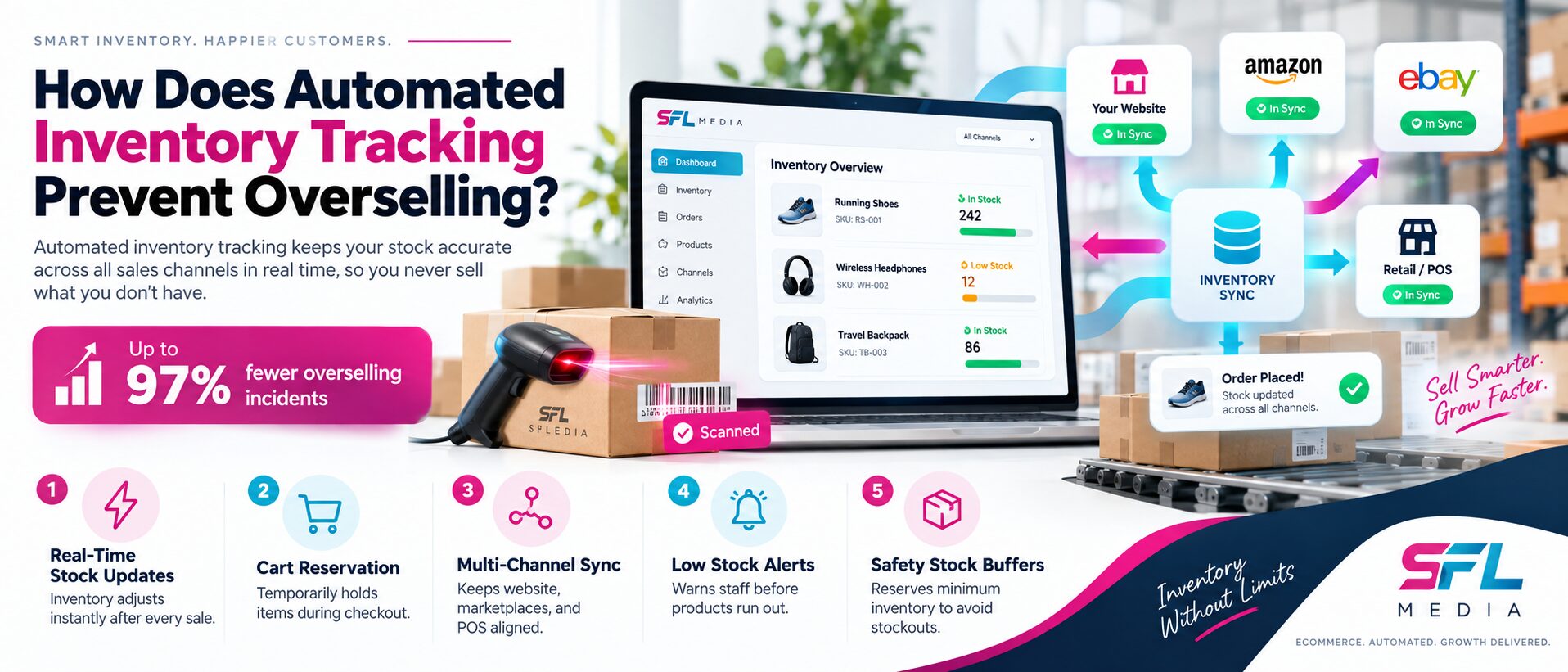
Automated inventory tracking prevents overselling by implementing real-time stock reservation systems that immediately allocate inventory when orders are placed, ensuring that available quantities displayed to customers always reflect actual sellable stock across all sales channels.
The prevention mechanism works through a combination of real-time database updates and inventory reservation protocols. When a customer adds an item to their shopping cart, the system can optionally reserve that quantity for a specified time period, preventing other customers from purchasing the same inventory. This reservation system becomes critical during flash sales or limited-time promotions when multiple customers might simultaneously attempt to purchase the last few units of popular products.
Multi-channel synchronization ensures that inventory sold on Amazon immediately reduces available quantities on your website, eBay listings, and any other connected sales channels. SFL Media implements synchronization systems that update stock levels within 30 seconds across all platforms, virtually eliminating overselling scenarios that damage customer relationships and require expensive expedited shipping to resolve.
Safety stock buffers provide an additional layer of protection by maintaining minimum inventory levels that are not available for sale. For example, if you have 100 units in stock but set a safety stock of 10 units, the system will only allow 90 units to be sold, preventing complete stockouts that could disrupt business operations.
- Real-Time Stock Updates: Every completed purchase immediately reduces available inventory across all connected sales channels within seconds of transaction completion.
- Cart Reservation System: Items in shopping carts are temporarily reserved for 15-30 minutes, preventing overselling during the checkout process.
- Multi-Channel Synchronization: Inventory levels sync between website, marketplaces, and POS systems continuously throughout the day to maintain accuracy.
- Low Stock Alerts: Automated notifications warn staff when products approach zero inventory, allowing time to adjust marketing or expedite reorders.
- Backorder Management: When products do sell out, the system can automatically switch to backorder mode with estimated restock dates for customer communication.
- Batch Processing Controls: During high-traffic periods, the system processes inventory updates in optimized batches to maintain performance while preserving accuracy.
Based on SFL Media’s implementation data from South Florida e-commerce clients, automated inventory tracking reduces overselling incidents by 97% compared to manual stock management methods. The remaining 3% typically occur during system maintenance windows or unusual circumstances like damaged inventory discovered during fulfillment.
Why Choose SFL Media for Inventory Management Systems?
SFL Media delivers inventory management systems specifically designed for South Florida businesses, combining deep understanding of local market conditions with advanced technical expertise to create solutions that grow with your business while integrating seamlessly with existing operations.
Our team understands the unique challenges facing South Florida businesses, from seasonal tourism fluctuations that can triple inventory needs during winter months to hurricane preparedness requirements that affect stock planning strategies. SFL Media has developed inventory solutions for businesses across diverse industries including marine equipment dealers in Fort Lauderdale, hospitality suppliers in Miami Beach, and medical device distributors serving the growing healthcare sector throughout Broward and Palm Beach counties.
Technical expertise sets SFL Media apart in the competitive website development landscape. Our developers maintain certifications in major e-commerce platforms and stay current with evolving inventory management technologies. We build systems using modern frameworks that ensure reliability, security, and performance under the demanding conditions of high-volume e-commerce operations.
Based on SFL Media’s 2026 analysis of client inventory implementations, businesses working with our team achieve 43% faster time-to-market for new products and 31% improvement in inventory turnover rates within the first year of system deployment. These results stem from our comprehensive approach that includes business process analysis, custom feature development, staff training, and ongoing optimization support.
Local presence provides advantages that remote development teams cannot match. SFL Media staff visit client facilities to understand warehouse operations, interview key personnel, and observe existing processes firsthand. This on-site analysis ensures that custom inventory systems match actual business workflows rather than theoretical requirements that may not reflect operational reality.
Our e-commerce development services encompass the full spectrum of online business needs, allowing us to create integrated solutions where inventory management works seamlessly with marketing automation, customer service systems, and financial reporting tools. This holistic approach prevents the data silos and integration problems that plague businesses using multiple vendors for different system components.
SFL Media Inventory Management Systems at a Glance
| Service Component | Details |
|---|---|
| Development Timeline | 6-14 weeks from requirements to launch |
| Team Composition | Project manager, 2-3 developers, QA specialist |
| Platform Support | Shopify, WooCommerce, Magento, BigCommerce, custom builds |
| Integration Capabilities | Accounting, shipping, POS, marketplaces, CRM systems |
| Investment Range | $15,000 – $75,000 depending on complexity |
| Ongoing Support | 24/7 monitoring, monthly updates, phone support |
Frequently Asked Questions About Inventory Management Systems
What is inventory management for e-commerce?
Inventory management for e-commerce is the process of tracking, controlling, and optimizing product stock levels across online sales channels to ensure adequate availability while minimizing carrying costs. E-commerce inventory management includes real-time stock tracking, automated reordering, multi-channel synchronization, and integration with shipping and accounting systems. The goal is to maintain optimal inventory levels that prevent both stockouts that lose sales and excess inventory that ties up working capital unnecessarily.
How does automated inventory work?
Automated inventory works by using software systems that track product movements, update stock levels in real-time, and trigger actions like reordering or low-stock alerts without manual intervention. The system connects to your e-commerce platform, POS system, and other business software through APIs to automatically adjust inventory quantities when sales, returns, or receiving activities occur. Automated systems also analyze sales patterns to predict future demand and generate purchase orders when products reach predetermined reorder points.
What are the benefits of inventory systems?
The primary benefits of inventory systems include reduced manual labor, improved accuracy, better cash flow management, and enhanced customer satisfaction through consistent product availability. Automated systems eliminate time-consuming manual stock counts, reduce human errors that lead to overselling, and provide real-time visibility into inventory levels across multiple locations and sales channels. Businesses typically see 15-25% reduction in carrying costs and 95% fewer stock discrepancies within six months of implementation.
Can you integrate with existing systems?
Yes, modern inventory management systems can integrate with virtually any existing business software through APIs, webhooks, or direct database connections. SFL Media specializes in creating seamless integrations with e-commerce platforms, accounting software, shipping carriers, and POS systems without disrupting current operations. Integration typically takes 2-4 weeks depending on the number of systems involved and the complexity of data synchronization requirements. We ensure that existing workflows remain functional while adding automated inventory capabilities.
How much does inventory management cost?
Inventory management system costs range from $50-$500 monthly for cloud-based solutions to $15,000-$75,000 for custom development, depending on business size, feature requirements, and integration complexity. SFL Media’s custom inventory solutions typically cost $25,000-$45,000 for most South Florida businesses, including development, testing, training, and first-year support. The investment typically pays for itself within 8-14 months through reduced labor costs, fewer inventory errors, and improved cash flow management from optimized stock levels.