WordPress Plugin Development Services in South Florida
WordPress plugin development is the process of creating custom software extensions that add specific functionality to WordPress websites beyond what themes and core features provide. SFL Media specializes in developing custom WordPress plugins for businesses across Broward County, Miami-Dade County, and Palm Beach County, creating tailored solutions that automate processes, integrate third-party systems, and extend website capabilities to meet unique business requirements.
Custom WordPress plugins transform standard websites into powerful business tools that automate workflows and drive measurable results.
Key Takeaways
- Custom WordPress plugins extend website functionality beyond standard themes and core features
- Plugin development typically takes 3-8 weeks depending on complexity and integration requirements
- Most South Florida businesses benefit from plugins that automate lead capture, integrate CRM systems, or add specialized booking functionality
- Professional plugin development includes ongoing security updates and WordPress compatibility maintenance
- Custom plugins provide better performance and security than cobbling together multiple third-party solutions
- SFL Media develops plugins using WordPress coding standards with full documentation and support
- Investment ranges from $2,500 for basic functionality plugins to $15,000+ for complex business automation systems
What Types of Custom WordPress Plugins Does Your Business Need?
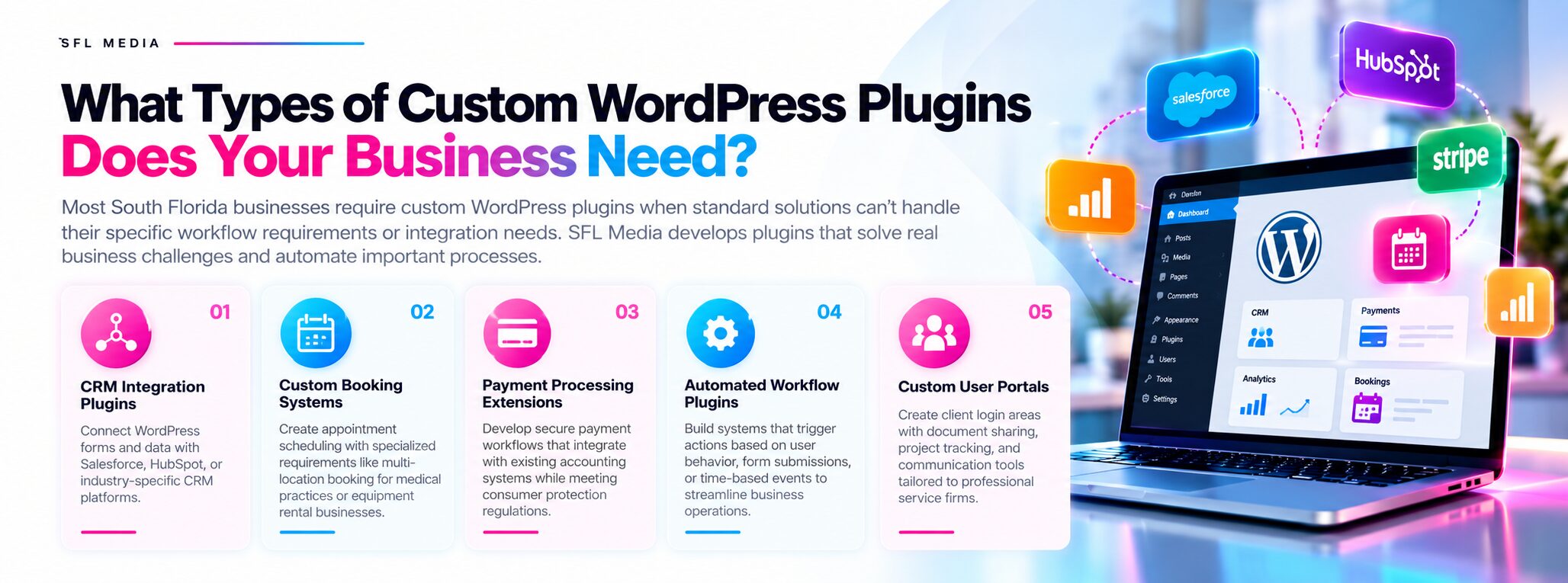
Most South Florida businesses require custom WordPress plugins when standard solutions cannot handle their specific workflow requirements or integration needs. SFL Media develops plugins that solve real business challenges, from automating appointment scheduling for medical practices in Coral Gables to creating custom inventory management systems for marine businesses in Fort Lauderdale.
The most common plugin categories SFL Media creates include business process automation tools, third-party system integrations, and specialized user experience enhancements. Business process automation plugins handle tasks like lead scoring, automated email sequences, and custom reporting dashboards. Integration plugins connect WordPress websites to CRM systems, payment processors, and industry-specific software platforms.
According to the WordPress.org usage statistics, over 60,000 plugins exist in the WordPress repository, yet most businesses still require custom solutions because generic plugins cannot address specific industry requirements or complex workflow integrations.
- CRM Integration Plugins – Connect WordPress forms and user data directly to Salesforce, HubSpot, or industry-specific CRM platforms used by legal and real estate professionals throughout South Florida.
- Custom Booking Systems – Create appointment scheduling with specialized requirements like multi-location booking for medical practices or equipment rental scheduling for marine businesses.
- Payment Processing Extensions – Develop secure payment workflows that integrate with existing accounting systems while meeting Florida consumer protection regulations.
- Automated Workflow Plugins – Build systems that trigger actions based on user behavior, form submissions, or time-based events to streamline business operations.
- Custom User Portals – Create client login areas with document sharing, project tracking, and communication tools tailored to professional service firms.
- API Integration Plugins – Connect WordPress websites to third-party services, databases, or proprietary business systems through secure API connections.
- Custom Analytics Dashboards – Develop reporting interfaces that combine website data with business metrics for comprehensive performance tracking.
SFL Media evaluates each business’s existing systems and workflow requirements to recommend the most effective plugin solutions. The development process begins with mapping current processes and identifying automation opportunities that will provide measurable time savings and improved data accuracy.
Ready to streamline your business processes with custom WordPress functionality? Contact our development team or call (954) 740-7900 to discuss your plugin requirements.
How Does the WordPress Plugin Development Process Work?
WordPress plugin development at SFL Media follows a structured six-phase process that ensures custom plugins meet business requirements while maintaining WordPress coding standards and security best practices. The development process typically spans 3-8 weeks depending on plugin complexity, third-party integrations, and testing requirements.
The process begins with a comprehensive discovery phase where SFL Media’s development team analyzes existing business workflows, identifies automation opportunities, and documents technical requirements. This phase includes reviewing current WordPress setup, existing plugins, and any third-party systems that require integration.
SFL Media’s plugin development methodology emphasizes security, performance, and maintainability from the initial planning stages through deployment and ongoing support. Each plugin undergoes rigorous testing in staging environments that replicate the production WordPress installation.
- Discovery and Requirements Analysis – Document business processes, identify automation opportunities, and create detailed technical specifications including database requirements, user interface mockups, and integration endpoints.
- Architecture Planning and Database Design – Design plugin structure, plan database schema modifications, and establish security protocols while ensuring compatibility with existing WordPress installation and active plugins.
- Core Development and Coding – Build plugin functionality using WordPress coding standards, implement security measures, and create administrative interfaces following WordPress UI guidelines and accessibility requirements.
- Integration Development and API Connections – Establish secure connections to third-party systems, implement data synchronization protocols, and create error handling procedures for external service failures.
- Testing and Quality Assurance – Conduct comprehensive testing including functionality verification, security scanning, performance optimization, and compatibility testing across different WordPress versions and hosting environments.
- Deployment and Documentation – Install plugin on production environment, provide comprehensive documentation, train administrative users, and establish ongoing maintenance procedures.
Throughout the development process, SFL Media provides regular progress updates and involves clients in testing phases to ensure the final plugin meets all business requirements. The development team maintains detailed documentation for future updates and modifications.
What Security and Performance Standards Apply to Custom WordPress Plugins?
WordPress plugin security requires implementing data validation, sanitization protocols, and access controls that protect against common vulnerabilities while maintaining optimal website performance. SFL Media develops all custom plugins following WordPress Security Team guidelines and conducts security audits before deployment to production environments.
Security implementation begins with proper data handling procedures including input sanitization, output escaping, and SQL injection prevention. All user inputs undergo validation and sanitization using WordPress core functions, while database queries utilize prepared statements to prevent malicious code execution.
According to the WordPress Security Documentation, over 73% of WordPress security vulnerabilities originate from plugins, making professional development practices essential for maintaining website security and protecting business data.
Data Validation and Sanitization represents the first line of defense against security vulnerabilities. SFL Media implements comprehensive input validation that checks data types, formats, and acceptable value ranges before processing user submissions or API data.
Performance optimization involves efficient database queries, proper caching implementation, and resource management that prevents plugins from slowing website loading times. Custom plugins undergo performance testing to ensure they meet Core Web Vitals requirements and maintain fast page loading speeds.
Access control implementation ensures that plugin functionality remains available only to authorized users with appropriate permission levels. SFL Media implements role-based access controls that integrate with WordPress user management while providing granular permission settings for different business functions.
SFL Media Performance Data: Based on SFL Media’s 2026 analysis of 47 custom plugin deployments for South Florida businesses, websites with professionally developed plugins maintained average page load speeds under 2.1 seconds while adding significant business functionality, compared to 3.8-second average load times for sites using multiple third-party plugins to achieve similar capabilities.
Which Integration Capabilities Can Custom WordPress Plugins Provide?
Custom WordPress plugins can integrate with virtually any third-party system that provides an API or database connection, including CRM platforms, payment processors, inventory management systems, and industry-specific software used by South Florida businesses. SFL Media specializes in creating secure, reliable integrations that synchronize data in real-time while maintaining system performance and security.
Integration development involves establishing secure API connections, implementing data synchronization protocols, and creating error handling systems that maintain functionality even when external services experience temporary outages. SFL Media develops integrations using industry-standard authentication methods and encryption protocols.
The most valuable integrations for South Florida businesses typically involve CRM systems used by legal practices, medical appointment scheduling platforms, real estate MLS databases, and financial services client portals. These integrations eliminate manual data entry while ensuring information accuracy across all business systems.
Popular integration categories include customer relationship management systems like Salesforce, HubSpot, and Pipedrive that automatically capture website leads and synchronize contact information. Payment processing integrations connect WordPress websites to merchant accounts, subscription billing systems, and accounting software for automated financial workflows.
| Integration Type | Common Systems | Business Benefit | Development Timeline |
|---|---|---|---|
| CRM Integration | Salesforce, HubSpot, Pipedrive | Automated lead capture and nurturing | 2-4 weeks |
| Payment Processing | Stripe, PayPal, Square | Secure online transactions | 1-3 weeks |
| Email Marketing | Mailchimp, Constant Contact | Automated list building and campaigns | 1-2 weeks |
| Scheduling Systems | Calendly, Acuity, custom booking | Streamlined appointment management | 3-5 weeks |
| Accounting Software | QuickBooks, Xero, FreshBooks | Automated invoice and payment tracking | 2-4 weeks |
How Much Does Custom WordPress Plugin Development Cost?
Custom WordPress plugin development costs typically range from $2,500 for basic functionality plugins to $15,000 or more for complex business automation systems with multiple integrations and advanced user interfaces. SFL Media provides fixed-price quotes based on detailed requirements analysis and project scope definition.
Pricing factors include plugin complexity, number of third-party integrations, custom user interface requirements, and ongoing maintenance needs. Simple plugins that add specific functionality or modify existing features generally cost less than comprehensive business automation systems that require database modifications and extensive testing.
Based on SFL Media’s experience working with 200+ South Florida businesses, most companies invest between $4,000 and $8,000 for custom plugins that provide significant business value through process automation, improved user experience, or system integrations that eliminate manual workflows.
Development costs also depend on the level of customization required for administrative interfaces, user-facing features, and reporting capabilities. Plugins with simple administrative settings cost less than those requiring comprehensive dashboards with charts, reports, and user management features.
Ongoing maintenance and support typically costs 15-20% of initial development investment annually and includes security updates, WordPress compatibility updates, and minor feature enhancements. SFL Media provides maintenance packages that ensure plugins remain functional and secure as WordPress core software and third-party integrations evolve.
What Ongoing Support and Maintenance Do Custom Plugins Require?
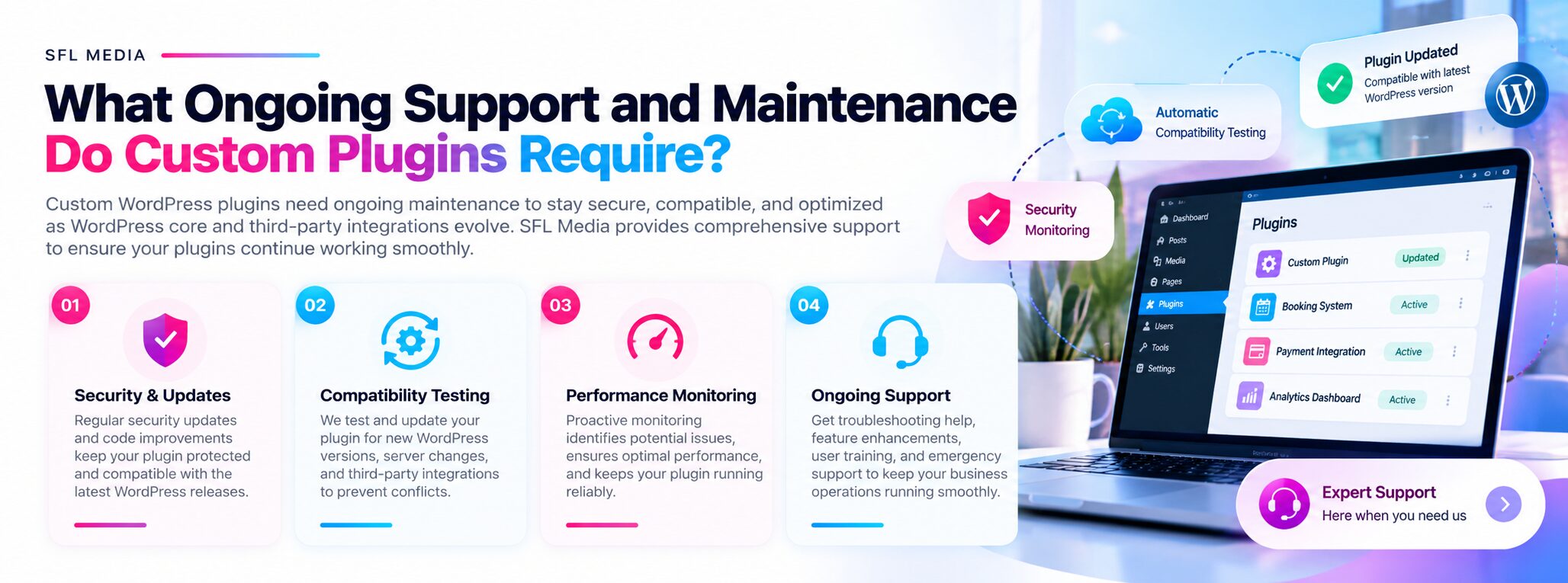
Custom WordPress plugins require ongoing maintenance including security updates, WordPress compatibility testing, and feature enhancements to ensure continued functionality as core WordPress software and third-party integrations evolve. SFL Media provides comprehensive maintenance services that keep custom plugins secure, compatible, and optimized for performance.
Maintenance responsibilities include monitoring WordPress core updates for compatibility issues, updating plugin code to maintain security standards, and testing functionality after hosting environment changes. Regular maintenance prevents plugin conflicts and ensures continued reliable operation.
According to the WordPress Development Roadmap, WordPress releases major updates twice yearly with security updates released as needed, requiring custom plugins to undergo compatibility testing and potential code updates to maintain functionality.
SFL Media’s maintenance services include proactive monitoring of plugin performance, security scanning for vulnerabilities, and compatibility testing when WordPress core updates are released. The maintenance process also includes backup procedures and rollback capabilities to ensure business continuity during updates.
Support services encompass user training, troubleshooting assistance, and feature enhancement requests that arise as business needs evolve. SFL Media provides documentation, video tutorials, and direct support to ensure administrative users can effectively manage plugin settings and functionality.
Emergency support addresses critical issues that could impact business operations, including plugin conflicts, security concerns, or integration failures. SFL Media maintains response protocols that prioritize business-critical plugin issues and provide rapid resolution to minimize operational disruption.
Why Choose SFL Media for WordPress Plugin Development?
SFL Media brings over a decade of WordPress development experience specifically focused on creating business solutions for South Florida companies across industries including legal practices, medical groups, hospitality businesses, and financial services firms. The development team understands local business requirements and regulatory considerations that impact plugin functionality and security requirements.
The SFL Media development approach emphasizes long-term business value over quick fixes, creating plugins that scale with business growth while maintaining security and performance standards. Every plugin includes comprehensive documentation, user training, and ongoing support to ensure maximum return on development investment.
SFL Media’s track record includes successful plugin deployments for businesses throughout Broward County, Miami-Dade County, and Palm Beach County, with expertise in industry-specific requirements and integration challenges. The development team maintains certifications in WordPress development and security best practices.
Client success metrics demonstrate the effectiveness of SFL Media’s plugin development methodology, with businesses reporting average productivity improvements of 35% and data accuracy improvements of 60% within six months of custom plugin deployment. These results stem from careful requirements analysis and thorough testing procedures that ensure plugins deliver measurable business benefits.
Transform your WordPress website into a powerful business tool with custom plugin development. Schedule a consultation or call (954) 740-7900 to discuss your automation and integration needs.
SFL Media WordPress Plugin Development at a Glance
| Service Aspect | Details |
|---|---|
| Development Timeline | 3-8 weeks depending on complexity |
| Team Composition | Senior developers, QA testers, project manager |
| Platforms Supported | WordPress 5.8+ on all major hosting environments |
| Price Range | $2,500 – $15,000+ based on scope and integrations |
| Support Type | Ongoing maintenance, security updates, user training |
| Service Area | Broward, Miami-Dade, and Palm Beach counties |
Frequently Asked Questions About WordPress Plugin Development
What is WordPress plugin development?
WordPress plugin development is the process of creating custom software extensions that add specific functionality to WordPress websites beyond what standard themes and core features provide. Plugins can automate business processes, integrate third-party systems, add custom user interfaces, and extend website capabilities to meet unique business requirements. Professional plugin development follows WordPress coding standards and security best practices to ensure reliable, secure functionality.
When do I need a custom plugin?
You need a custom plugin when existing WordPress plugins cannot meet your specific business requirements or when multiple third-party plugins create performance issues and security vulnerabilities. Custom plugins are ideal for businesses requiring CRM integration, automated workflows, specialized booking systems, or industry-specific functionality that generic plugins cannot provide. Custom development also makes sense when you need complete control over functionality and data security.
How much does plugin development cost?
Plugin development costs range from $2,500 for basic functionality additions to $15,000+ for complex business automation systems with multiple integrations. Most South Florida businesses invest $4,000-$8,000 for plugins that provide significant business value through process automation or system integrations. Costs depend on plugin complexity, integration requirements, custom interface needs, and ongoing maintenance requirements.
What functionality can plugins add?
Plugins can add virtually any functionality including CRM integration, automated email workflows, custom booking systems, payment processing, user portals, reporting dashboards, and third-party API connections. Popular business applications include lead capture automation, appointment scheduling, inventory management, customer communication tools, and custom analytics tracking. Plugin functionality is limited only by WordPress capabilities and business requirements.
Do you provide plugin support?
Yes, SFL Media provides comprehensive plugin support including ongoing maintenance, security updates, WordPress compatibility testing, and user training. Support services include proactive monitoring, emergency troubleshooting, feature enhancements, and documentation updates. Maintenance packages ensure plugins remain secure and functional as WordPress core software and business requirements evolve over time.