
According to HubSpot’s 2026 Marketing Report, businesses with documented content marketing strategies generate 3x more leads than those relying solely on traditional advertising. Your content marketing strategy determines whether website visitors scroll past your brand or become loyal customers. The difference lies in creating content that addresses real customer pain points while guiding prospects through your sales funnel.
South Florida businesses from Miami to Fort Lauderdale face intense competition for customer attention. A well-executed content marketing strategy cuts through the noise by delivering value first, building trust, and positioning your brand as the obvious choice when prospects are ready to buy.
Content marketing strategy success depends on matching your audience’s search intent with content that solves their specific problems at each stage of the buyer’s journey.
What Makes a Content Marketing Strategy Actually Work?
A successful content marketing strategy combines audience research, strategic content planning, and systematic conversion optimization to turn casual readers into customers. SFL Media’s approach focuses on creating content that serves dual purposes: providing genuine value to your audience while strategically moving them toward a purchase decision.
The foundation starts with understanding your customer’s journey. According to Salesforce research, 79% of business buyers consume 3-5 pieces of content before engaging with a sales representative. Your content marketing strategy must address each stage: awareness, consideration, and decision-making.
Effective content planning involves mapping specific content types to buyer journey stages. Blog posts and educational guides work well for awareness-stage prospects. Case studies and comparison articles convert consideration-stage visitors. Product demonstrations and customer testimonials close decision-stage prospects.
SFL Media’s South Florida clients see the biggest improvements when they align content topics with actual customer questions. This approach ensures every piece of content serves a strategic purpose rather than just filling a content calendar.
How Do You Research and Define Your Content Audience?
Audience research for content marketing starts with analyzing your existing customer data to identify patterns in demographics, behavior, and pain points. SFL Media recommends beginning with customer interviews, website analytics, and social media insights to build detailed buyer personas that guide content creation decisions.
Google Analytics 4 provides valuable audience insights through the Demographics and Interests reports. Look for patterns in age groups, geographic locations, and interests that correlate with your highest-value customers. For South Florida businesses, this often reveals distinct differences between Miami, Fort Lauderdale, and West Palm Beach audiences.
Customer service teams hold goldmines of content ideas. They hear the same questions repeatedly, understand common objections, and know what information helps prospects make buying decisions. Document these conversations to identify content gaps in your current strategy.
Social media listening tools reveal how your audience discusses industry topics, what language they use, and which content formats generate engagement. This research informs both content topics and the tone of voice that resonates with your specific market.
Content Planning and Editorial Calendar Development
Content planning transforms scattered ideas into a systematic approach that consistently moves prospects toward conversion. A strategic editorial calendar balances educational content with promotional materials while maintaining regular publishing schedules that keep your audience engaged.
Start by categorizing content into three buckets: educational (70%), industry insights (20%), and promotional (10%). This ratio ensures you provide value consistently while creating opportunities to showcase your expertise and services. Educational content builds trust and authority. Industry insights position you as a thought leader. Promotional content converts interested prospects.
Plan content themes around your business cycles and customer needs. SFL Media’s Fort Lauderdale team maps content to seasonal trends, industry events, and customer buying patterns. For example, B2B companies often see increased engagement in January and September when businesses plan for new quarters.
Use content clusters to improve search visibility and user experience. Choose a broad topic relevant to your audience, then create multiple related pieces that link to each other. This approach helps search engines understand your expertise while giving readers multiple entry points to discover your brand.
Content Format Selection
Different content formats serve different purposes in your marketing strategy. Blog posts work well for educational content and search engine optimization. Video content increases engagement and social sharing. Infographics simplify complex information. Case studies provide social proof and demonstrate results.
| Content Format | Best Use Case | Average Engagement Rate |
|---|---|---|
| Blog Posts | SEO and thought leadership | 2.4% click-through rate |
| Video Content | Social media and demos | 6.8% engagement rate |
| Infographics | Complex data visualization | 3.2% share rate |
| Case Studies | Conversion and social proof | 4.1% conversion rate |
| Email Newsletters | Nurturing and retention | 21.3% open rate |
Creating High-Converting Content That Engages Your Audience
High-converting content combines compelling storytelling with strategic calls-to-action that guide readers toward desired actions. The key lies in addressing specific customer problems while demonstrating your unique solution without being overly promotional.
Start every piece of content with a hook that immediately addresses your reader’s pain point or curiosity. According to Chartbeat data, you have approximately 15 seconds to capture a visitor’s attention before they leave your page. Use specific examples, surprising statistics, or relatable scenarios rather than generic introductions.
Structure content for easy scanning with subheadings, bullet points, and short paragraphs. Most readers scan content before deciding whether to read thoroughly. Clear formatting helps them quickly identify relevant sections and encourages deeper engagement with your material.
Include strategic calls-to-action throughout your content, not just at the end. Offer relevant resources, invite newsletter subscriptions, or suggest related content that keeps visitors engaged with your brand. SFL Media places soft CTAs after providing valuable insights to capitalize on reader interest.
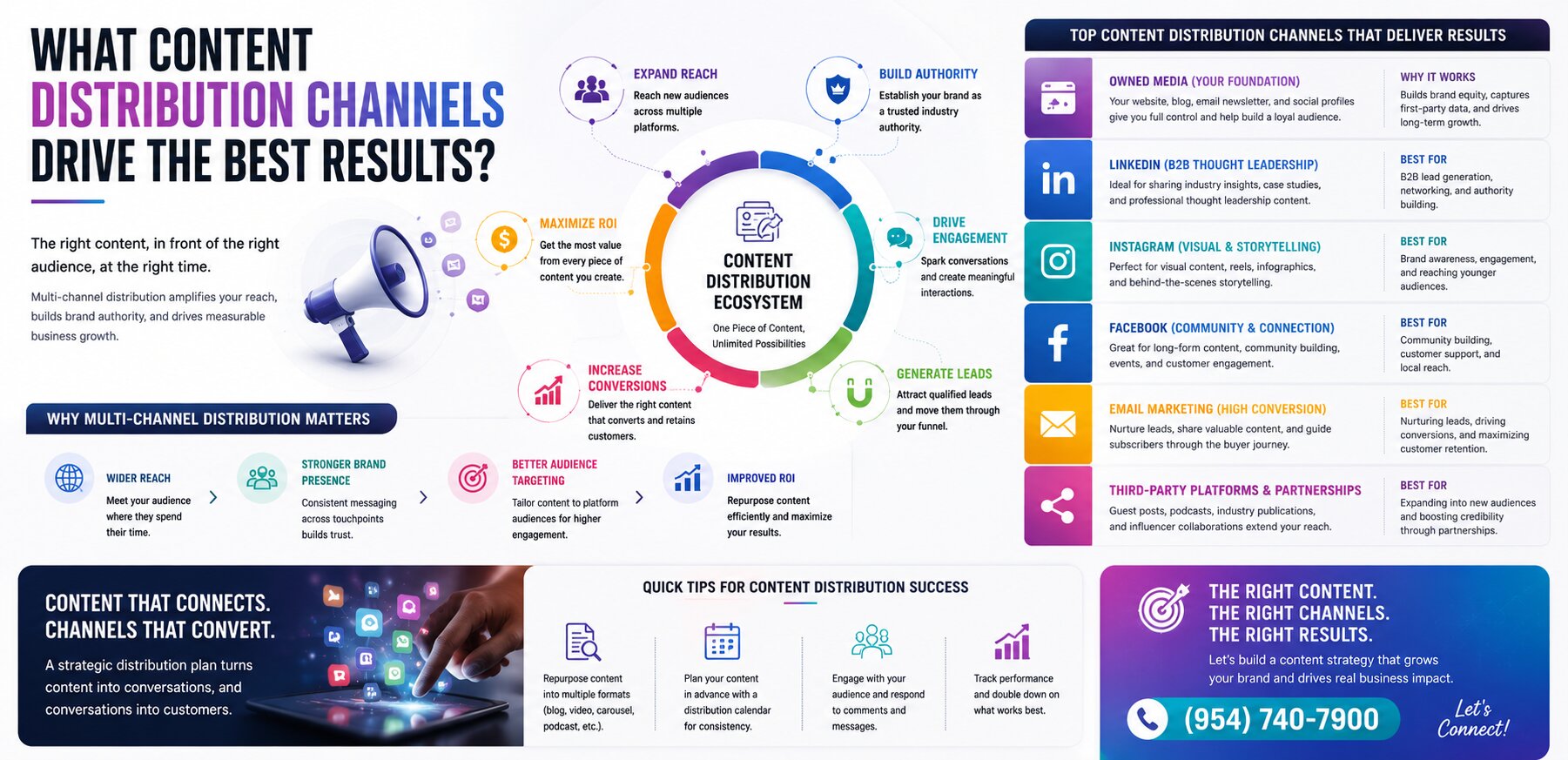
What Content Distribution Channels Drive the Best Results?
Content distribution success depends on matching your content format with platforms where your target audience actively seeks information. Multi-channel distribution amplifies reach while allowing you to repurpose content across different formats and contexts.
Owned media channels provide the foundation for content distribution. Your website blog, email newsletter, and social media profiles give you complete control over messaging and user experience. These channels also capture valuable audience data for retargeting and personalization efforts.
Social media platforms require platform-specific adaptations of your core content. LinkedIn works well for B2B thought leadership articles. Instagram favors visual content and behind-the-scenes stories. Facebook supports longer-form content and community building. Tailor your approach to each platform’s unique audience expectations.
Email marketing remains one of the highest-converting distribution channels for content marketing. Segment your email list based on interests and buyer journey stage to deliver relevant content that moves subscribers toward conversion. Include clear calls-to-action and track which content types generate the most engagement.
Measuring Content Marketing Performance and ROI
Content marketing measurement requires tracking both engagement metrics and business outcomes to understand which content types and topics drive actual results. Focus on metrics that connect directly to revenue rather than vanity metrics that look impressive but don’t impact your bottom line.
Key performance indicators for content marketing include organic traffic growth, lead generation, email subscriber growth, and customer acquisition cost reduction. According to Content Marketing Institute research, companies that excel at content marketing see 7.8x more site traffic than those with poor content strategies.
Track content performance at the individual piece level to identify patterns in high-performing topics, formats, and distribution channels. Use Google Analytics 4 to monitor page views, time on page, and conversion paths. This data reveals which content pieces contribute most to lead generation and sales.
Calculate content marketing ROI by comparing content creation costs against revenue generated from content-driven leads. Include both direct conversions and assisted conversions where content played a role in the customer journey. SFL Media’s South Florida clients typically see positive ROI within 6-12 months of implementing strategic content marketing.
Final Thoughts on Content Marketing Strategy Success
A successful content marketing strategy requires consistent execution, continuous optimization, and patience to see compound results over time. The businesses that succeed focus on providing genuine value to their audience while strategically guiding prospects through a well-designed conversion process.
SFL Media has helped dozens of South Florida companies transform their content marketing from random blog posts into systematic lead generation engines. The key lies in treating content marketing as a long-term investment rather than a quick fix, with success measured by business outcomes rather than content metrics alone.
Ready to develop a content marketing strategy that actually converts visitors into customers? Contact our Fort Lauderdale team or call (954) 740-7900 to discuss your content marketing goals and create a strategy tailored to your South Florida market.
Frequently Asked Questions About Content Marketing Strategy
What is a content marketing strategy?
A content marketing strategy is a documented plan for creating, distributing, and measuring content that attracts your target audience and drives profitable customer actions. It includes audience research, content planning, distribution channels, and performance metrics that align with your business goals. Successful strategies focus on providing value while guiding prospects through your sales funnel.
How do I create engaging content?
Create engaging content by addressing specific customer problems with actionable solutions, using compelling headlines, and structuring information for easy scanning. Start with customer research to understand their pain points and preferred content formats. Include real examples, data, and stories that resonate with your audience’s experiences and challenges.
What types of content convert best?
Case studies, product demonstrations, and comparison guides typically convert best because they address decision-stage buyer concerns. Educational blog posts and how-to guides work well for building awareness and trust. Email newsletters and retargeting content help nurture prospects over time. The best-converting content matches your audience’s current stage in the buying journey.
How often should I publish new content?
Publish new content consistently based on your audience’s expectations and your capacity to maintain quality. Most successful businesses publish 1-2 high-quality blog posts per week, with additional content on social media and email newsletters. Consistency matters more than frequency, so choose a schedule you can maintain long-term without sacrificing content quality.
How do I measure content marketing success?
Measure content marketing success through organic traffic growth, lead generation, email subscribers, and revenue attribution to content-driven conversions. Track engagement metrics like time on page and social shares, but focus on business outcomes like customer acquisition cost and lifetime value. Use Google Analytics 4 and your CRM to connect content consumption to actual sales results.