
E-commerce website design determines whether visitors become customers or click away to competitors. According to Baymard Institute, the average cart abandonment rate sits at 70.19% in 2026, with poor website design being a primary culprit. Your online store’s success depends on creating an intuitive, conversion-focused experience that guides shoppers seamlessly from browsing to buying.
South Florida businesses face intense online competition, making professional e-commerce design more critical than ever. Whether you’re launching a new store or redesigning an existing one, the right design elements can dramatically increase your conversion rates and revenue. SFL Media has helped countless Fort Lauderdale, Miami, and West Palm Beach businesses transform their online presence into profit-generating machines.
E-commerce success starts with user-centered design that removes friction from every step of the buying journey.
What Makes E-commerce Website Design Different from Regular Websites?
E-commerce website design focuses exclusively on driving sales and conversions, unlike informational websites that prioritize content consumption. Every element serves a specific purpose in the buying journey, from product discovery to checkout completion. The design must build trust, showcase products effectively, and eliminate any barriers that might prevent a purchase.
Online stores require specialized functionality that standard websites don’t need. Shopping carts, inventory management, payment processing, and order tracking all demand careful integration into the user experience. SFL Media’s South Florida e-commerce clients see immediate improvements when we implement conversion-focused design principles rather than generic website layouts.
Trust signals become paramount in e-commerce design. Customers need confidence to share payment information and make purchases from businesses they’ve never visited in person. Security badges, customer reviews, clear return policies, and professional product photography all contribute to building the credibility necessary for online sales success.
How Do You Optimize Product Pages for Maximum Conversions?
Product page design directly influences purchase decisions, with high-quality images being the most important element for online shoppers. According to BigCommerce research, 78% of online shoppers want to see multiple product images before making a purchase decision. Your product pages must showcase items from every angle with zoom functionality and lifestyle shots that help customers visualize ownership.
Product descriptions should focus on benefits rather than features, addressing customer pain points and desires. Include technical specifications in a separate section for detail-oriented buyers, but lead with emotional appeals and practical benefits. Clear pricing, availability status, and shipping information prevent confusion that leads to cart abandonment.
Customer reviews and ratings provide social proof that significantly impacts conversion rates. Display them prominently on product pages, including both star ratings and written reviews. SFL Media integrates review systems that automatically collect feedback and display it strategically to maximize their conversion impact for our South Florida retail clients.
Essential E-commerce Features Every Online Store Needs
- Advanced Search and Filtering: Customers should find products quickly using search bars, category filters, price ranges, and sorting options. Poor search functionality frustrates shoppers and drives them to competitors.
- Wishlist and Save for Later: Allow customers to bookmark products they’re considering. This feature captures potential sales that might otherwise be lost and provides valuable data about customer preferences.
- Guest Checkout Option: Forcing account creation increases abandonment rates. Offer guest checkout while encouraging account creation through incentives rather than requirements.
- Live Chat Support: Real-time assistance during the shopping process helps overcome objections and answer questions that prevent purchases. Automated chatbots can handle common inquiries 24/7.
- Mobile-Responsive Design: With mobile commerce representing over 50% of online sales, your store must function flawlessly on smartphones and tablets with touch-friendly navigation and fast loading times.
- Inventory Management Integration: Real-time stock levels prevent overselling and customer disappointment. Display availability clearly and offer backorder options when appropriate.
What Are the Best Practices for E-commerce Checkout Design?
Checkout optimization can immediately boost conversion rates, with streamlined processes reducing abandonment by up to 35%. The checkout should be a single-page process or clearly show progress through multiple steps. Minimize form fields to only essential information and use auto-fill capabilities to speed completion.
Multiple payment options accommodate different customer preferences and increase completion rates. Accept major credit cards, PayPal, Apple Pay, Google Pay, and other popular payment methods. Display security badges and SSL certificates prominently to reassure customers about payment safety.
Transparent pricing prevents checkout abandonment caused by unexpected costs. Show all fees, taxes, and shipping charges early in the process, ideally on product pages or cart summaries. Offer shipping calculators so customers know total costs before beginning checkout. SFL Media’s Fort Lauderdale e-commerce clients see significant improvements when we implement transparent pricing strategies.
| Checkout Element | Best Practice | Impact on Conversions |
|---|---|---|
| Form Fields | Minimize to essential only | 15-20% improvement |
| Payment Options | 5+ methods including digital wallets | 10-15% improvement |
| Progress Indicators | Clear step-by-step display | 8-12% improvement |
| Security Badges | Visible SSL and trust seals | 5-10% improvement |
| Guest Checkout | No forced registration | 20-25% improvement |
How Does Website Speed Impact E-commerce Success?
Website speed directly affects e-commerce conversions, with Google recommending a Largest Contentful Paint (LCP) under 2.5 seconds for optimal user experience. According to Google’s Core Web Vitals, page speed is now an official ranking factor that impacts both search visibility and user satisfaction. Every second of delay can reduce conversions by up to 7%.
Product images often cause the biggest speed bottlenecks in e-commerce sites. Optimize images through compression, use next-generation formats like WebP, and implement lazy loading so images only load when needed. Consider using content delivery networks (CDNs) to serve images from servers closest to your customers.
Mobile speed becomes even more critical as smartphone users expect instant loading. Implement Accelerated Mobile Pages (AMP) for key product categories and ensure your mobile site passes Google’s mobile-friendly test. SFL Media optimizes e-commerce sites for Miami, Fort Lauderdale, and West Palm Beach businesses to achieve sub-2-second load times across all devices.
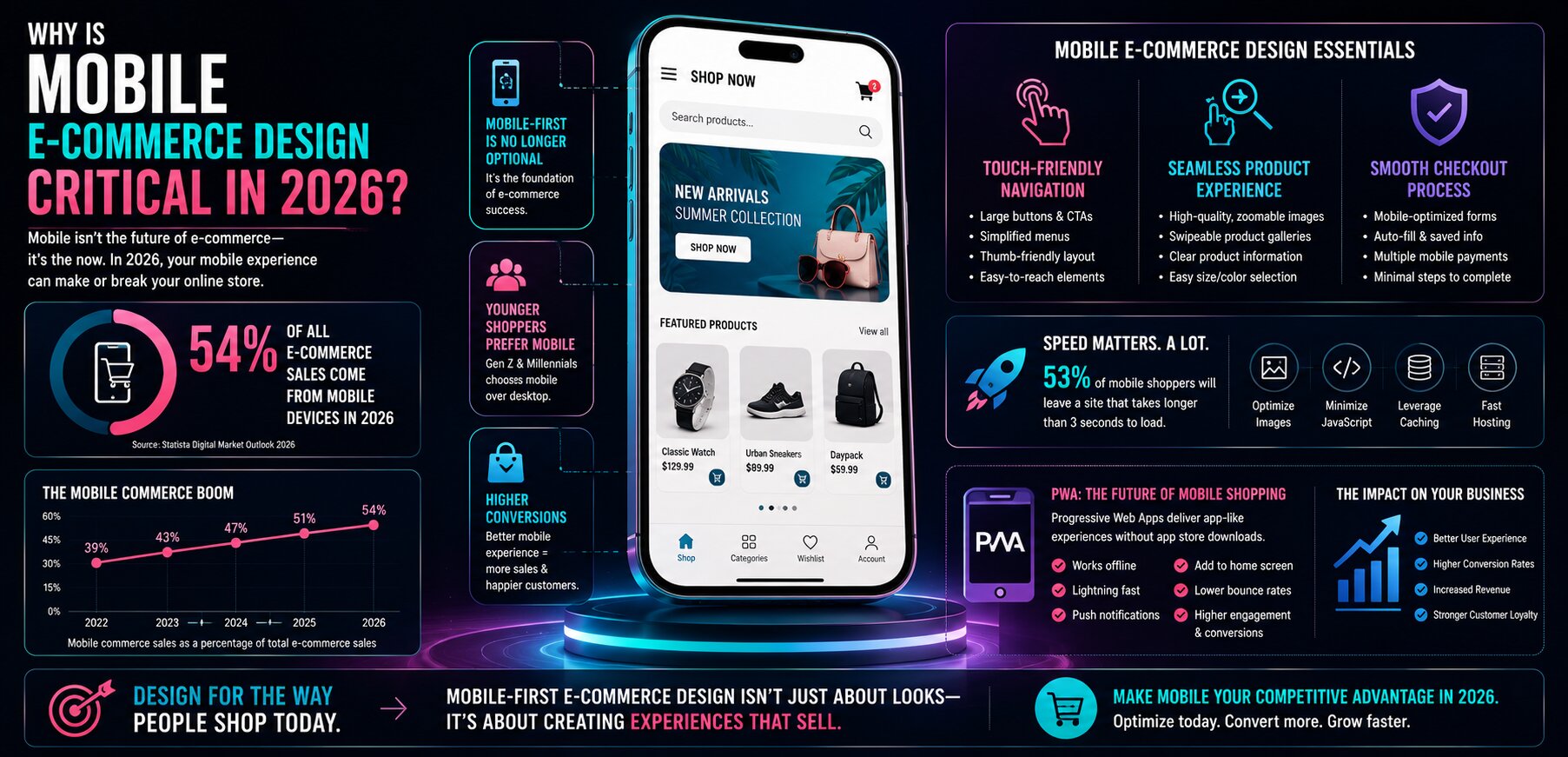
Why Is Mobile E-commerce Design Critical in 2026?
Mobile commerce accounts for 54% of all e-commerce sales in 2026, making mobile-first design essential for online store success. According to Statista, mobile shopping continues growing year-over-year, with younger demographics preferring mobile over desktop for online purchases. Your e-commerce design must prioritize mobile experience over desktop considerations.
Touch-friendly navigation requires larger buttons, simplified menus, and thumb-friendly placement of key elements. Product images should be easily zoomable with pinch gestures, and checkout forms must work seamlessly with mobile keyboards and auto-fill features. Consider implementing swipe gestures for product galleries and intuitive mobile search functionality.
Mobile page speed becomes even more critical with slower cellular connections and limited data plans. Optimize images aggressively, minimize JavaScript, and prioritize above-the-fold content loading. Progressive Web App (PWA) technology can provide app-like experiences without requiring downloads, improving engagement and conversion rates for mobile shoppers.
Final Thoughts on E-commerce Website Design Success
E-commerce website design success depends on understanding your customers’ needs and removing every possible barrier to purchase. The most beautiful design means nothing if it doesn’t convert visitors into buyers. Focus on user experience, site speed, mobile optimization, and trust-building elements that directly impact your bottom line.
Professional e-commerce design requires expertise in conversion optimization, technical implementation, and ongoing testing. Small improvements in checkout flow, product page layout, or site speed can generate significant revenue increases. SFL Media helps South Florida businesses create e-commerce experiences that turn browsers into loyal customers.
Ready to transform your online store into a conversion machine? Contact our Fort Lauderdale team for a comprehensive e-commerce design audit, or call (954) 740-7900 to discuss your project today.
Frequently Asked Questions About E-commerce Website Design
What makes a good e-commerce website design?
A good e-commerce website design prioritizes user experience, fast loading speeds, and clear conversion paths from product discovery to checkout completion. Essential elements include high-quality product images, intuitive navigation, mobile responsiveness, secure checkout processes, and trust signals like customer reviews and security badges. The design should eliminate friction at every step while building confidence in your brand and products.
How do I optimize my online store for conversions?
Optimize your online store for conversions by streamlining the checkout process, improving product page design, and implementing trust signals throughout the shopping experience. Focus on site speed optimization, mobile responsiveness, clear pricing and shipping information, multiple payment options, and prominent customer reviews. Regular A/B testing of key elements like button colors, product descriptions, and checkout flows helps identify what works best for your specific audience.
What are essential e-commerce features?
Essential e-commerce features include advanced search and filtering, shopping cart functionality, wishlist capabilities, guest checkout options, inventory management, customer account areas, and order tracking systems. Additional important features are live chat support, customer reviews and ratings, related product recommendations, email marketing integration, and comprehensive analytics tracking. Security features like SSL certificates and PCI compliance are non-negotiable requirements.
How do I design effective product pages?
Design effective product pages by featuring multiple high-quality images with zoom functionality, compelling product descriptions that focus on benefits, clear pricing and availability information, and prominent customer reviews. Include detailed specifications in an organized format, related product suggestions, and clear call-to-action buttons. Optimize for mobile viewing and ensure fast loading times while maintaining visual appeal and comprehensive product information.
What is the best checkout process for e-commerce?
The best checkout process for e-commerce is a streamlined, single-page or clearly progressive multi-step system that minimizes form fields and offers guest checkout options. Include multiple payment methods, transparent pricing with all fees displayed upfront, progress indicators, security badges, and auto-fill capabilities. Provide order summaries, easy editing options, and clear error messaging while maintaining fast loading speeds and mobile optimization throughout the entire process.