
Online reputation management determines whether potential customers trust your business before they ever walk through your door. According to BrightLocal’s 2025 Consumer Review Survey, 93% of consumers read online reviews before making a purchase decision, and 34% won’t consider a business with fewer than 4 stars. Your digital reputation isn’t just about damage control anymore.
In 2026, businesses across Miami, Fort Lauderdale, and West Palm Beach face increasing scrutiny as review platforms multiply and consumer expectations rise. A single negative review can now spread across Google, Facebook, Yelp, and industry-specific platforms within hours. SFL Media has helped South Florida businesses transform their online presence by implementing systematic reputation management strategies that build trust and drive revenue.
Businesses that actively manage their online reputation see 25% more revenue growth than those that ignore customer feedback across digital platforms.
Why Online Reputation Management Matters for Your Business
Online reputation management directly affects your search rankings, customer acquisition, and revenue growth. Google’s algorithm considers review signals when determining local search rankings, meaning businesses with better ratings appear higher in search results. According to Harvard Business School research, a one-star increase in Yelp ratings leads to a 5-9% increase in revenue for restaurants.
The impact extends beyond immediate sales. Poor online reputation creates a compound effect where negative reviews discourage positive customers from sharing their experiences, creating a downward spiral. SFL Media’s Fort Lauderdale clients have seen this pattern reversed through proactive reputation management, with some businesses increasing their average rating by 1.2 stars within six months.
Review platforms now influence hiring decisions, partnership opportunities, and even loan approvals. Banks and investors routinely check business ratings during due diligence processes. Your online reputation has become a business asset that requires the same attention as your financial statements or marketing campaigns.
How to Monitor Your Business Reviews Across All Platforms
Effective review monitoring requires tracking mentions across Google My Business, Facebook, Yelp, industry-specific sites, and social media platforms simultaneously. Most businesses discover negative reviews days or weeks after publication, missing the critical window for timely response. According to ReviewTrackers, businesses that respond to reviews within 24 hours receive 12% more positive reviews than those that respond later.
Set up Google Alerts for your business name, key personnel, and common misspellings. Configure notifications on each review platform where your business appears. Many South Florida businesses use tools like Podium, BirdEye, or Grade.us to centralize monitoring, but manual checking remains necessary for comprehensive coverage.
SFL Media recommends creating a monitoring schedule that includes daily Google My Business checks, weekly social media scans, and monthly deep dives into industry-specific platforms. Document every review in a spreadsheet with response status, sentiment, and follow-up actions. This systematic approach ensures no feedback goes unaddressed.
What Should You Do When You Receive Negative Reviews?
Respond to negative reviews within 24 hours with empathy, accountability, and a clear path toward resolution. Never argue with reviewers publicly or make excuses that shift blame to customers, employees, or circumstances. The goal isn’t winning the argument but demonstrating professionalism to future customers reading the exchange.
Start every response by thanking the reviewer for their feedback, acknowledge their specific concerns, and apologize for their negative experience. Offer to continue the conversation privately through direct message, email, or phone call. Include your contact information to show transparency and commitment to resolution.
Follow this response template: “Thank you for taking the time to share your experience, [Name]. I apologize that [specific issue] didn’t meet your expectations. We take this feedback seriously and would like to make this right. Please contact me directly at [email/phone] so we can discuss how to improve your experience.” SFL Media has used variations of this approach to help Miami and West Palm Beach businesses turn negative reviews into positive customer relationships.
Proven Strategies to Generate More Positive Reviews
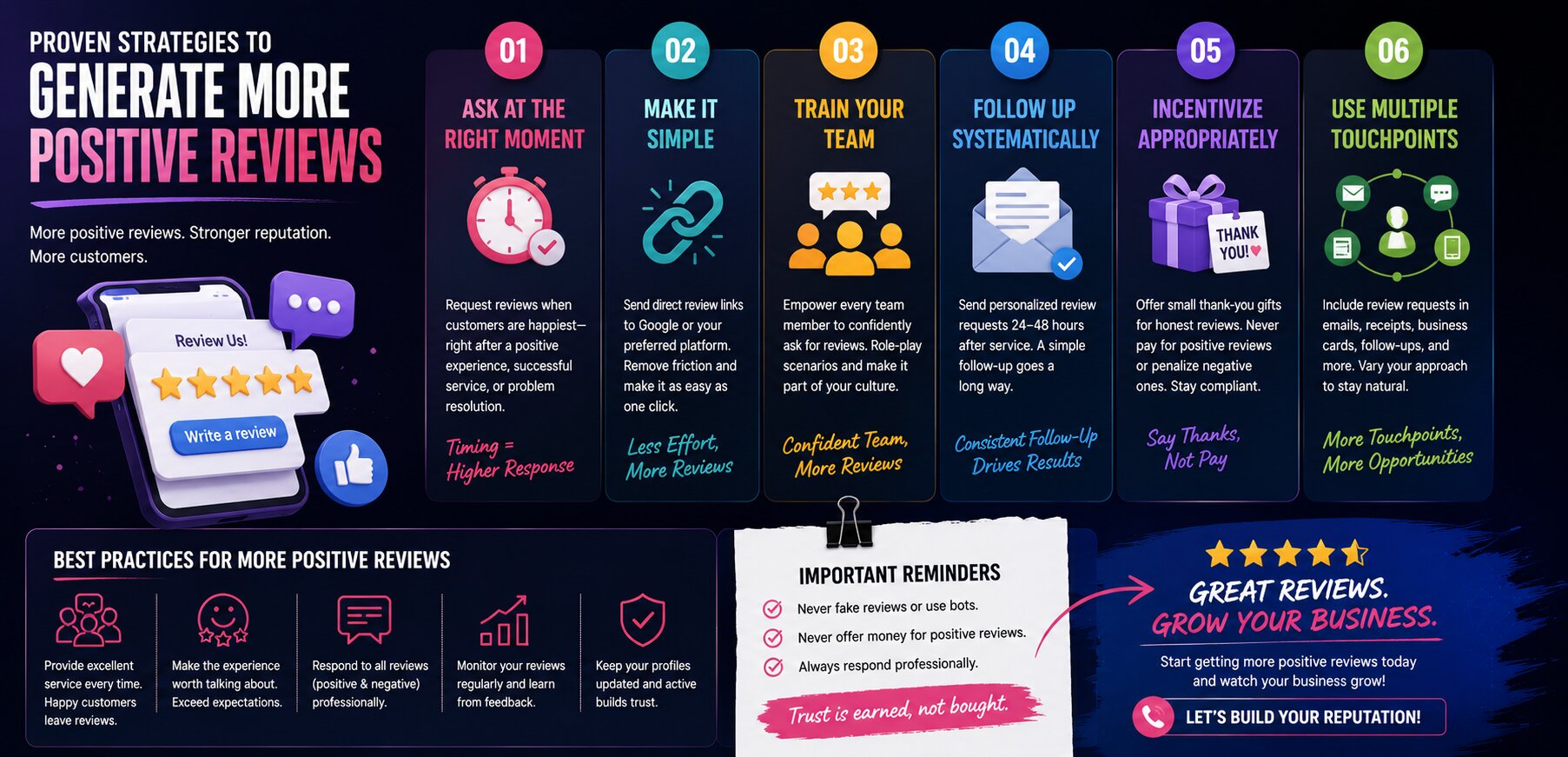
- Ask at the right moment: Request reviews immediately after positive interactions, successful service completion, or problem resolution. Timing matters more than frequency.
- Make it simple: Send direct links to your Google My Business or preferred review platform. Remove friction by eliminating multiple steps or platform searches.
- Train your team: Every employee should know how to ask for reviews naturally during customer interactions. Role-play different scenarios during team meetings.
- Follow up systematically: Send review requests via email 24-48 hours after service completion. Include personalized details about their specific experience.
- Incentivize appropriately: Offer small thank-you gifts for honest reviews, but never pay for positive reviews or penalize negative ones. This violates platform policies.
- Use multiple touchpoints: Include review requests in receipts, email signatures, business cards, and follow-up communications. Vary your approach to avoid seeming pushy.
Essential Tools for Online Reputation Management
| Tool Category | Best Options | Key Features | Pricing Range |
|---|---|---|---|
| All-in-One Platforms | BirdEye, Podium, Grade.us | Multi-platform monitoring, automated requests, response management | $300-800/month |
| Free Monitoring | Google Alerts, Social Mention | Basic mention tracking, email notifications | Free |
| Social Listening | Hootsuite, Sprout Social | Social media monitoring, sentiment analysis | $99-249/month |
| Review Analytics | ReviewTrackers, Reputation.com | Competitive analysis, trend reporting, sentiment tracking | $119-500/month |
How Long Does It Take to Improve Your Online Reputation?
Meaningful reputation improvement typically requires 3-6 months of consistent effort, depending on your starting point and review volume. Businesses with fewer than 10 reviews can see dramatic changes within weeks by generating new positive feedback. Companies with extensive negative review histories need longer timeframes to dilute poor ratings with fresh positive content.
The mathematical reality of review platforms works in your favor over time. If you have 20 reviews averaging 2.5 stars, adding 30 five-star reviews brings your average to 4.1 stars. SFL Media tracks this progression for South Florida clients using monthly scorecards that measure rating improvements, response rates, and review volume increases.
Expect initial resistance from previously frustrated customers who may test your commitment to improvement. Consistent professional responses and genuine service improvements typically convert skeptics into advocates within the first quarter of active reputation management.
Ready to transform your online reputation and attract more South Florida customers? Contact our reputation management team or call (954) 740-7900 for a free reputation audit and strategy consultation.
Final Thoughts on Online Reputation Management
Online reputation management isn’t a one-time project but an ongoing business discipline that requires consistent attention and systematic processes. The businesses that thrive in 2026 treat customer feedback as valuable market research while maintaining professional standards across all digital touchpoints. Your reputation becomes your competitive advantage when managed strategically.
SFL Media’s reputation management services help Fort Lauderdale businesses build sustainable systems for monitoring, responding to, and generating reviews across all major platforms. We’ve seen firsthand how proactive reputation management transforms customer relationships and drives measurable business growth throughout South Florida.
Start implementing these strategies today, but remember that authentic reputation improvement requires genuine service excellence behind the digital facade. Focus on delivering exceptional customer experiences, then systematically capture and showcase that value through strategic online reputation management.
Frequently Asked Questions About Online Reputation Management
What is online reputation management?
Online reputation management is the practice of monitoring, influencing, and improving how your business appears in online search results and review platforms. It involves tracking mentions across Google, social media, and review sites, responding professionally to feedback, and implementing strategies to generate positive reviews while addressing negative ones.
How do I respond to negative reviews?
Respond within 24 hours with empathy and professionalism, acknowledge specific concerns, apologize for the negative experience, and offer to resolve the issue privately. Never argue publicly or make excuses. Focus on demonstrating your commitment to customer satisfaction for future customers reading the exchange.
How can I get more positive reviews?
Ask for reviews at the right moment after positive interactions, make the process simple with direct platform links, train your team to request feedback naturally, and follow up systematically via email 24-48 hours after service completion. Consistency and timing matter more than frequency.
What tools help monitor online reputation?
Use Google Alerts for free basic monitoring, or invest in comprehensive platforms like BirdEye, Podium, or ReviewTrackers for multi-platform tracking, automated notifications, and response management. Social listening tools like Hootsuite help monitor social media mentions and sentiment.
How do reviews affect my business?
Reviews directly impact search rankings, customer acquisition, and revenue, with studies showing a one-star rating increase can lead to 5-9% revenue growth. According to recent surveys, 93% of consumers read reviews before purchasing, and 34% won’t consider businesses with fewer than 4 stars.