According to Hootsuite’s 2026 Social Media Report, businesses using a social media content calendar see 78% higher engagement rates than those posting randomly. A social media content calendar is a strategic planning tool that organizes your posts, campaigns, and content themes across all platforms in advance.
For South Florida businesses in Miami, Fort Lauderdale, and West Palm Beach, consistent social media presence directly impacts local customer acquisition and brand recognition. SFL Media has helped hundreds of regional companies transform their scattered posting habits into strategic content machines that drive real business results.
Strategic content planning eliminates last-minute scrambling and ensures every post serves a specific business purpose.
Why Your Business Needs a Social Media Content Calendar
A social media content calendar provides structure and consistency that directly translates to better business outcomes. SFL Media’s Fort Lauderdale team has tracked client performance data showing that planned content generates 3x more qualified leads than spontaneous posts.
Content calendars eliminate the daily stress of “what should we post today?” Instead, your team focuses on executing a proven strategy. This systematic approach allows for better resource allocation, improved content quality, and measurable ROI tracking.
According to Social Media Examiner’s 2026 Industry Report, 89% of marketers report that organized content planning reduces their weekly workload by at least 6 hours. The time savings compound when you batch content creation and use scheduling tools effectively.
For South Florida service businesses, content calendars also ensure you capture seasonal opportunities like hurricane preparedness campaigns, beach season promotions, or snowbird marketing windows that drive significant local revenue.
How Do I Create an Effective Social Media Content Calendar?
Creating an effective social media content calendar starts with auditing your current performance and defining clear business objectives for each platform. SFL Media recommends beginning with a 30-day pilot calendar before expanding to quarterly planning cycles.
- Audit Current Performance: Export analytics from each platform covering the last 90 days. Identify your top-performing post types, optimal posting times, and engagement patterns.
- Define Content Pillars: Choose 3-4 core themes that align with business goals. Examples include educational content, behind-the-scenes posts, customer testimonials, and industry insights.
- Map Platform-Specific Strategies: Instagram content differs significantly from LinkedIn posts. Tailor your calendar to each platform’s unique audience expectations.
- Establish Posting Frequency: Start conservative with 3-5 posts per week per platform. Quality consistency beats overwhelming your audience with mediocre content.
- Build Content Batches: Dedicate specific days to content creation. Batch photography, video recording, and copywriting to maximize efficiency.
- Schedule Review Cycles: Plan weekly calendar reviews to adjust for trending topics, news events, or campaign performance data.
What Tools Should You Use for Social Media Scheduling?
Social media scheduling tools automate posting while providing analytics that inform future content decisions. SFL Media’s South Florida clients achieve the best results using platform-native schedulers combined with comprehensive management tools.
| Tool Category | Best For | Key Features | Price Range |
|---|---|---|---|
| Meta Business Suite | Facebook & Instagram | Native scheduling, detailed analytics | Free |
| Hootsuite | Multi-platform management | Team collaboration, content library | $49-$739/month |
| Buffer | Small business simplicity | Clean interface, basic analytics | $15-$99/month |
| Sprout Social | Enterprise-level features | Advanced reporting, CRM integration | $249-$499/month |
Platform-native tools like Meta Business Suite and TikTok Creator Studio often provide better algorithm performance than third-party schedulers. However, managing multiple accounts requires centralized tools that streamline workflow and reporting.
When Should You Post for Maximum Engagement?
Optimal posting times depend on your specific audience behavior, not generic industry averages. According to Sprout Social’s 2026 engagement data, the best posting times vary by up to 400% between different business types and geographic locations.
SFL Media analyzes client data to identify peak engagement windows for South Florida audiences. Local businesses typically see higher engagement during commute hours (7-9 AM and 5-7 PM EST) and weekend afternoons when people browse social media more leisurely.
Test different posting times systematically rather than following generic advice. Post the same content type at different hours across two weeks, then analyze engagement metrics to identify your audience’s specific patterns. Platform analytics show when your followers are most active, providing a data-driven starting point for optimization.
Platform-Specific Timing Considerations
Instagram posts perform best during lunch hours and evening downtime, while LinkedIn content generates more engagement during business hours Tuesday through Thursday. Facebook’s algorithm favors consistent posting schedules over sporadic high-frequency bursts.
How Do You Measure Content Calendar Success?
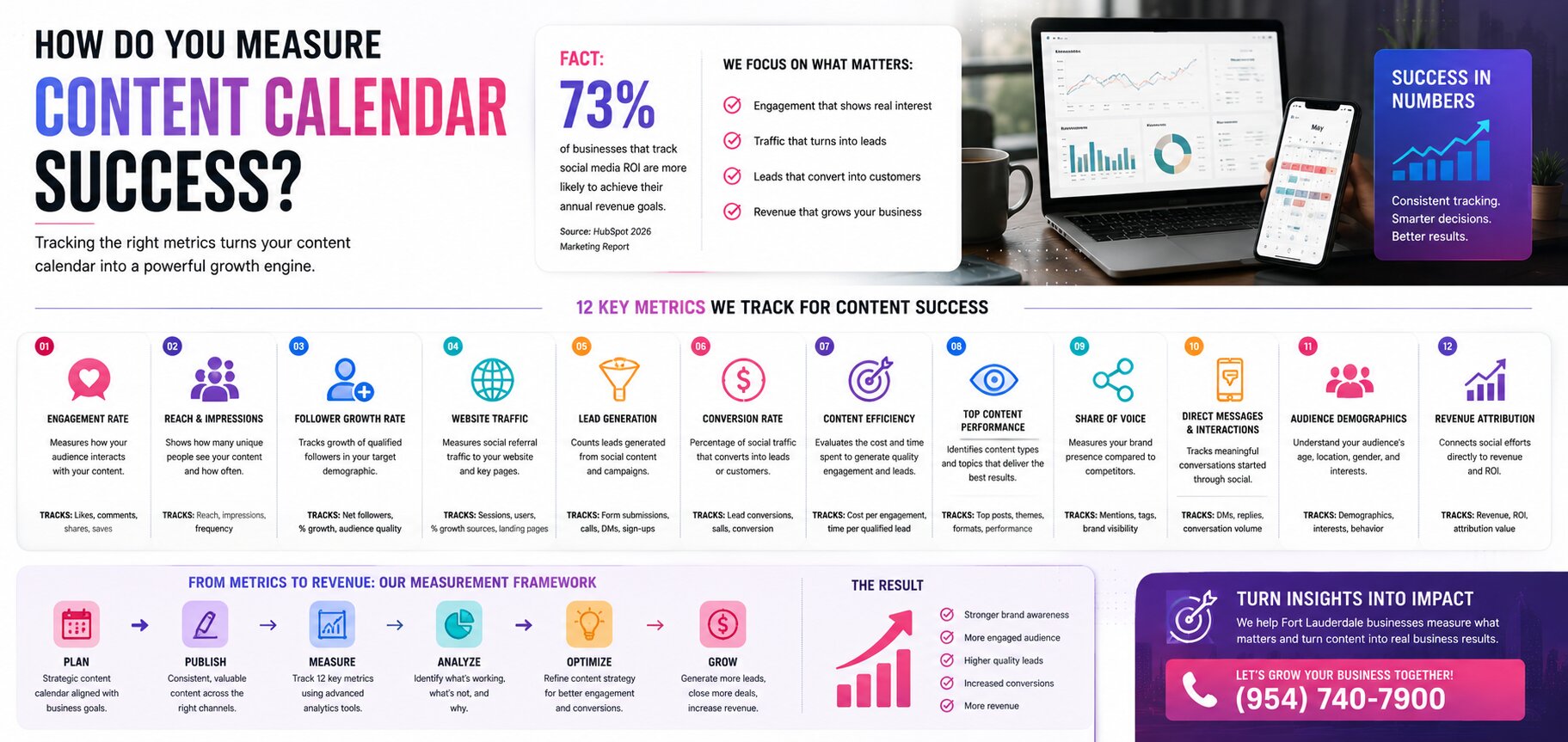
Content calendar success measurement requires tracking both engagement metrics and business outcomes that directly impact revenue. SFL Media tracks 12 key performance indicators for Fort Lauderdale clients, focusing on metrics that correlate with actual customer acquisition and retention.
Engagement rate remains the primary indicator of content resonance, calculated as total engagements divided by total followers. However, reach and impression data reveal whether your content calendar successfully expands brand awareness beyond existing audiences.
According to HubSpot’s 2026 Marketing Report, businesses tracking social media ROI are 73% more likely to achieve their annual revenue goals. Connect social metrics to website traffic, lead generation, and sales conversion data using UTM parameters and platform pixel tracking.
- Engagement Quality: Monitor comments, shares, and saves rather than just likes. These actions indicate genuine interest and brand affinity.
- Follower Growth Rate: Track monthly percentage increases in qualified followers within your target demographic and geographic area.
- Website Traffic: Measure social referral traffic using Google Analytics 4, focusing on pages that drive business inquiries or sales.
- Lead Generation: Count contact form submissions, phone calls, and direct messages that originate from social media content.
- Content Efficiency: Calculate cost per engagement and time invested per qualified lead to optimize resource allocation.
What Content Types Drive the Highest Engagement?
Video content generates 67% higher engagement rates than static images across all major social platforms. SFL Media’s South Florida clients see the strongest performance from short-form educational videos, customer testimonial clips, and behind-the-scenes content that humanizes their brand.
User-generated content performs exceptionally well for local businesses because it provides authentic social proof while expanding reach through customer networks. Encourage customers to share experiences using branded hashtags, then feature this content in your calendar with proper attribution.
Interactive content types like polls, questions, and carousel posts boost engagement by inviting audience participation. According to Instagram’s 2026 Creator Report, Stories with interactive elements receive 28% more replies than passive content.
Content Mix Strategy
Balance promotional content with educational and entertaining posts using the 80/20 rule. Eighty percent of content should provide value without direct selling, while twenty percent can include clear calls-to-action for your products or services. This ratio builds trust and audience loyalty that converts more effectively than constant promotion.
Final Thoughts on Social Media Content Calendar Planning
A well-executed social media content calendar transforms random posting into strategic brand building that drives measurable business results. The key lies in consistent execution, regular performance analysis, and continuous optimization based on audience feedback and engagement data.
SFL Media has helped hundreds of South Florida businesses build content calendars that generate qualified leads and increase local market share. The investment in strategic planning pays dividends through improved efficiency, better engagement rates, and stronger customer relationships.
Start with a simple 30-day calendar focusing on quality over quantity. Test different content types, posting times, and engagement strategies while tracking metrics that matter to your business goals. Success comes from persistence and data-driven refinement, not perfect execution from day one.
Ready to build a social media content calendar that drives real business results for your South Florida company? Contact our Fort Lauderdale team or call (954) 740-7900 for a free content strategy consultation.
Frequently Asked Questions About Social Media Content Calendar
How do I create a social media content calendar? Start by auditing your current social media performance and defining 3-4 content pillars that align with business goals. Choose a planning tool like Google Sheets or specialized software, then map out 30 days of content including post types, captions, and optimal posting times for each platform.
What is the best time to post on social media? The best posting times depend on your specific audience behavior rather than generic industry averages. Analyze your platform analytics to identify when your followers are most active, then test different posting schedules systematically to find peak engagement windows for your business.
How often should I post on social media? Post frequency should prioritize consistency over volume, with 3-5 quality posts per week per platform being optimal for most businesses. Daily posting works for brands with dedicated content teams, but inconsistent high-frequency posting often performs worse than regular moderate-frequency schedules.
What tools can I use for social media scheduling? Use platform-native tools like Meta Business Suite for Facebook and Instagram, combined with comprehensive management platforms like Hootsuite or Buffer for multi-platform coordination. Native schedulers often provide better algorithm performance, while third-party tools offer superior workflow management and analytics.
How do I measure social media engagement? Calculate engagement rate by dividing total engagements (likes, comments, shares, saves) by total followers, then track business outcomes like website traffic, lead generation, and sales conversions using UTM parameters and platform pixels to measure true ROI from social media efforts.