
TV advertising ROI remains one of the most challenging metrics to track, with according to Nielsen, only 38% of advertisers confident in their television campaign measurement accuracy. Despite streaming services and digital platforms reshaping viewership patterns, television advertising still delivers substantial returns when properly measured and optimized. The key lies in establishing clear attribution models and tracking the right combination of direct response and brand awareness metrics.
For businesses across Miami, Fort Lauderdale, and West Palm Beach, understanding TV advertising ROI has become critical as media costs continue rising in South Florida’s competitive markets. SFL Media has helped dozens of local companies implement comprehensive measurement frameworks that capture both immediate conversions and long-term brand lift from their television campaigns.
Television advertising ROI measurement requires tracking both immediate response metrics and long-term brand impact to capture the full value of your media investment.
What Is TV Advertising ROI and Why Does It Matter?
TV advertising ROI is the ratio of revenue generated from television campaigns compared to the total cost of media spend, creative production, and campaign management. Unlike digital advertising where every click gets tracked, television ROI measurement combines direct attribution data with statistical modeling to estimate campaign impact. According to Marketing Accountability Standards Board, effective TV ROI measurement captures both short-term sales lift and long-term brand equity building.
Television advertising creates multiple value streams that traditional ROI calculations often miss. Immediate response metrics show direct conversions within hours or days of ad exposure. Brand awareness lift drives consideration and purchase intent that converts weeks or months later. Cross-channel amplification occurs when TV ads boost performance of digital, radio, and print campaigns running simultaneously.
SFL Media’s Fort Lauderdale clients typically see TV advertising ROI ranging from 2:1 to 8:1 depending on industry, creative quality, and measurement sophistication. Restaurants and retail businesses often achieve higher immediate returns, while B2B and professional services see stronger long-term brand building effects. The key is setting realistic expectations and measuring the right combination of metrics for your specific business model.
How Do You Calculate TV Advertising ROI Accurately?
TV advertising ROI calculation starts with establishing a clear attribution window and baseline measurement period before campaign launch. The basic formula divides incremental revenue by total campaign costs, but accurate measurement requires isolating television’s specific contribution from other marketing activities. Statistical methods like matched market testing, econometric modeling, and incrementality studies provide the most reliable TV ROI calculations.
Direct attribution tracking captures immediate responses through unique phone numbers, promo codes, and dedicated landing pages mentioned in TV commercials. According to Google, businesses using multiple attribution methods see 23% higher accuracy in TV ROI measurement compared to single-method approaches. Cross-device tracking connects TV exposure to online conversions by matching viewing data with digital behavior patterns.
Advanced measurement combines first-party data with third-party audience verification services. SFL Media implements custom tracking setups that connect TV flight schedules with website traffic spikes, call volume increases, and store visit lift. This multi-touch attribution reveals how television advertising influences the entire customer journey from initial awareness through final purchase decision.
What Metrics Should You Track for Television Campaign Success?
Television advertising metrics fall into three categories: reach and frequency data, direct response indicators, and brand impact measurements. Reach metrics show how many unique viewers saw your commercials, while frequency tracks average exposure per person. Direct response metrics capture immediate actions like website visits, phone calls, and store traffic increases during and immediately after ad airings.
| Metric Category | Key Indicators | Measurement Window |
|---|---|---|
| Direct Response | Website traffic, phone calls, promo code usage | 0-7 days post-airing |
| Brand Awareness | Aided/unaided recall, search volume lift | 1-4 weeks post-campaign |
| Sales Impact | Revenue lift, new customer acquisition | 2-12 weeks post-campaign |
| Cross-Channel | Digital campaign performance, social engagement | During and 4 weeks post-campaign |
Brand impact metrics require survey research or third-party brand tracking services. Aided brand awareness measures recognition when your company name is presented in a list. Unaided awareness captures spontaneous brand recall without prompting. Purchase intent and brand favorability scores indicate long-term campaign effectiveness beyond immediate sales results.
SFL Media tracks organic search volume increases for brand terms and product categories during TV flight periods. Search lift often provides the clearest signal of television advertising impact, with spikes occurring within minutes of commercial airings. Social media engagement and website direct traffic also correlate strongly with TV ad exposure timing.
Setting Up Proper Attribution Windows
Attribution windows define how long after TV exposure you’ll credit conversions to television advertising. Immediate response typically occurs within 0-3 days, while brand-driven conversions can happen 30-90 days later. According to Marketing Science Institute, optimal attribution windows vary by industry, with retail averaging 14 days and automotive extending to 120 days.
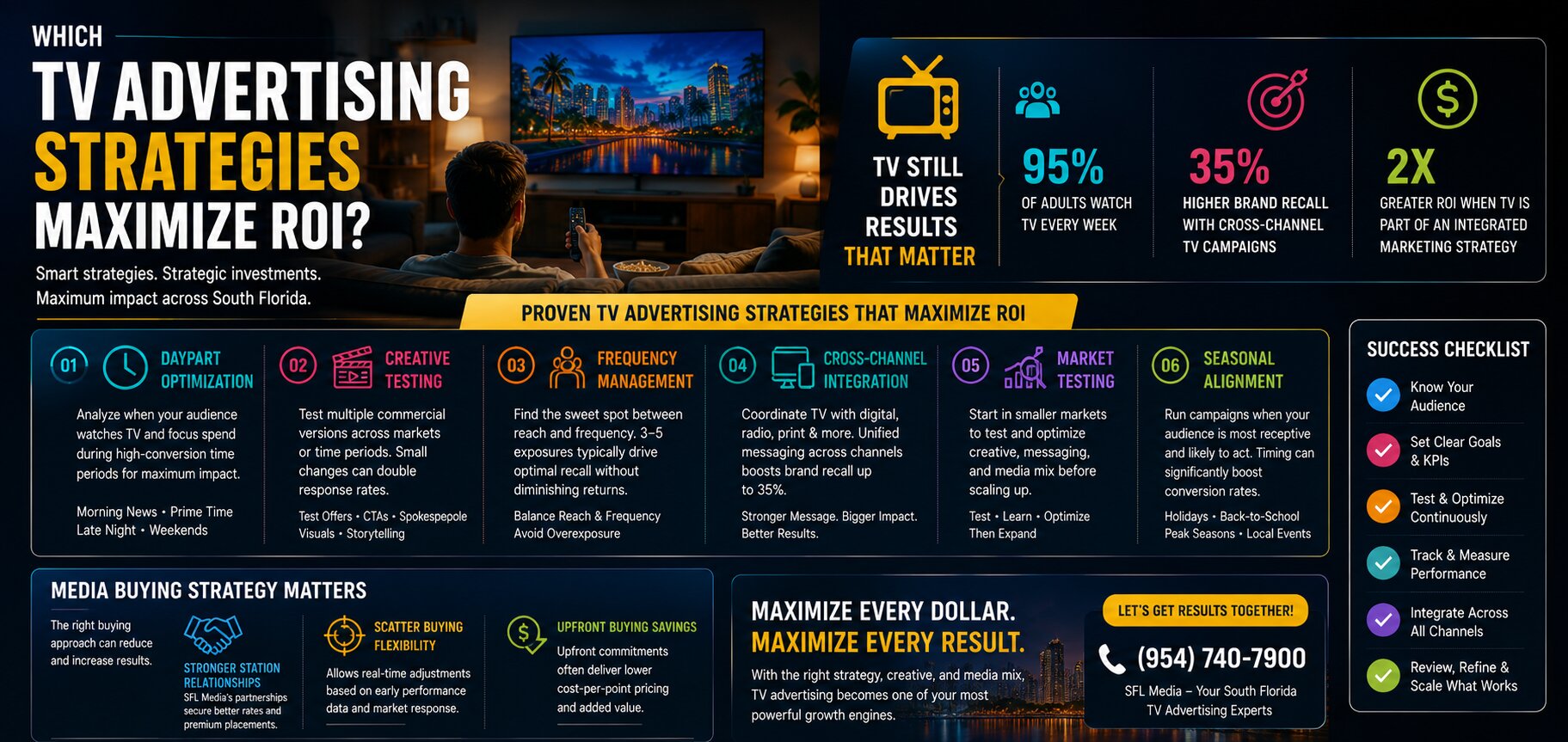
Which TV Advertising Strategies Maximize ROI?
- Daypart Optimization: Analyze when your target audience watches television and concentrate spend during high-conversion time periods. Morning news, prime time, and late-night programming deliver different audience compositions and response rates.
- Creative Testing: Develop multiple commercial versions and test performance across different markets or time periods. Small creative changes in call-to-action placement, offer presentation, or spokesperson selection can double response rates.
- Frequency Management: Balance reach versus frequency to avoid oversaturation while ensuring adequate message repetition. Most products require 3-5 exposures for optimal recall without diminishing returns from overexposure.
- Cross-Channel Integration: Coordinate TV advertising with digital, radio, and print campaigns to amplify overall impact. Synchronized messaging across channels increases brand recall by up to 35% compared to television-only approaches.
- Market Testing: Start with smaller markets to optimize creative, messaging, and media mix before expanding to larger, more expensive television markets across South Florida.
- Seasonal Alignment: Time campaigns during periods when your target audience is most receptive and likely to take action. Holiday seasons, back-to-school periods, and industry-specific peak times deliver higher conversion rates.
Media buying strategy significantly impacts TV advertising ROI through negotiated rates, placement optimization, and audience targeting. SFL Media’s relationships with South Florida television stations secure better rates and premium placement opportunities for our clients. Scatter buying allows flexibility to adjust based on early performance data, while upfront commitments often provide lower cost-per-point pricing.
How Can You Improve TV Campaign Performance Over Time?
TV campaign optimization requires continuous testing and refinement based on performance data analysis. Weekly performance reviews identify which dayparts, programs, and creative executions drive the strongest response rates. Successful optimization focuses on shifting budget toward high-performing elements while eliminating or improving underperforming campaign components.
Creative refresh strategies prevent audience fatigue while maintaining message consistency. According to WARC, television commercials lose effectiveness after 4-6 weeks of heavy rotation, making creative rotation essential for sustained performance. A/B testing different commercial lengths, from 15-second to 60-second spots, reveals optimal message delivery for your specific audience.
Advanced optimization techniques include econometric modeling to understand interaction effects between television and other marketing channels. SFL Media uses statistical analysis to identify the optimal media mix allocation across TV, digital, radio, and outdoor advertising for maximum combined ROI. This integrated approach often reveals that television advertising amplifies digital campaign performance by 20-40%.
Real-time optimization adjusts media schedules based on daily performance indicators. If Monday morning spots consistently outperform Friday evening placements, budget shifts toward higher-performing dayparts. Weather, news events, and competitive activity also influence TV advertising effectiveness, requiring flexible media plans that adapt to changing conditions.
Final Thoughts on Television Advertising ROI Measurement
Television advertising ROI measurement combines art and science, requiring both robust tracking systems and strategic interpretation of complex data relationships. The most successful campaigns establish clear measurement frameworks before launch, track multiple attribution methods, and continuously optimize based on performance insights. While digital advertising offers more granular tracking, television’s mass reach and emotional impact create substantial value when properly measured and managed.
For South Florida businesses considering television advertising, the key to success lies in realistic expectation setting, comprehensive measurement planning, and patient optimization over multiple campaign flights. SFL Media’s experience across Miami-Dade, Broward, and Palm Beach County markets provides the local expertise needed to navigate regional media landscape complexities and audience preferences.
Ready to maximize your TV advertising ROI with expert measurement and optimization strategies? Contact our Fort Lauderdale team or call (954) 740-7900 to discuss your television advertising goals and develop a comprehensive measurement plan.
Frequently Asked Questions About TV Advertising ROI
How do you measure TV advertising ROI? TV advertising ROI is measured by dividing incremental revenue generated by total campaign costs, using attribution methods like unique tracking numbers, promo codes, and statistical modeling. Most accurate measurement combines direct response tracking with brand lift studies and cross-channel impact analysis. Attribution windows typically range from 7 days for immediate response to 90 days for brand-driven conversions.
What metrics should I track for TV ads? Essential TV advertising metrics include reach and frequency data, direct response indicators like website traffic and phone calls, brand awareness lift, and sales impact measurement. Track immediate responses within 0-7 days, brand metrics within 1-4 weeks, and sales impact over 2-12 weeks post-campaign. Cross-channel amplification effects on digital and social media performance provide additional value measurement.
How can I improve my TV advertising results? Improve TV advertising results through daypart optimization, creative testing, frequency management, and cross-channel integration with digital campaigns. Test multiple commercial versions, concentrate spend during high-conversion time periods, and coordinate messaging across all marketing channels. Continuous optimization based on weekly performance data and creative refresh every 4-6 weeks prevents audience fatigue.
What is a good ROI for television advertising? Good TV advertising ROI typically ranges from 2:1 to 8:1 depending on industry, with retail and restaurants often achieving higher immediate returns than B2B services. Consumer goods average 3-5:1 ROI, while professional services may see 2-3:1 immediate returns plus significant long-term brand building value. Local markets often deliver higher ROI than national campaigns due to reduced competition and lower media costs.
How do I calculate TV ad campaign effectiveness? Calculate TV ad campaign effectiveness by establishing baseline performance metrics before campaign launch, then measuring incremental lift across sales, website traffic, brand awareness, and cross-channel performance. Use matched market testing, econometric modeling, or incrementality studies for most accurate attribution. Compare campaign periods to control periods or non-TV markets to isolate television’s specific contribution to business results.