According to Cybersecurity Ventures, hackers attack websites every 39 seconds, with small businesses facing the highest risk of targeted attacks. Website security best practices have become non-negotiable for businesses across Miami, Fort Lauderdale, and West Palm Beach as cyber threats continue to evolve. The financial impact of a security breach averages $4.45 million per incident in 2026.
SFL Media’s Fort Lauderdale team has witnessed firsthand how proper security implementation protects South Florida businesses from devastating cyber attacks. The difference between a secure website and a vulnerable one often determines whether a business survives a targeted attack or faces weeks of downtime and reputation damage.
Website security is not optional in 2026 – it’s the foundation that determines whether your business thrives or becomes another cybercrime statistic.
Why Website Security Matters More Than Ever in 2026
Website security directly impacts your business revenue, customer trust, and search engine rankings simultaneously. Google penalizes compromised websites by removing them from search results entirely, while customers who encounter security warnings never return to make purchases. According to IBM Security, 83% of organizations have experienced more than one data breach, with the average time to identify a breach taking 207 days.
The financial consequences extend far beyond immediate losses. Businesses face regulatory fines, legal fees, customer notification costs, and credit monitoring services for affected users. SFL Media’s South Florida clients who implemented comprehensive security measures before attacks occurred avoided an average of $2.3 million in potential damages during 2025.
Search engines now treat security as a ranking factor, meaning unsecured websites lose organic traffic even without being directly attacked. Your website’s security status affects every aspect of your digital presence, from email deliverability to social media integration functionality.
What Are the Most Critical Website Security Vulnerabilities?
SQL injection attacks remain the most dangerous website vulnerability, allowing hackers to access entire databases through poorly secured input fields. Cross-site scripting (XSS) attacks inject malicious code into trusted websites, stealing user credentials and session data. Outdated software components create entry points for automated attacks that scan millions of websites daily for known vulnerabilities.
Weak password policies enable brute force attacks that systematically guess login credentials until they succeed. Many Fort Lauderdale businesses still use default administrator usernames and simple passwords that automated tools crack within hours. SFL Media’s security audits consistently reveal that 67% of websites use plugins or themes that haven’t received security updates in over six months.
File upload vulnerabilities allow attackers to place malicious scripts directly onto web servers through contact forms, image uploads, or document submission features. These backdoor access points often remain undetected for months while criminals steal data or use servers for cryptocurrency mining operations.
Essential SSL Certificate Implementation
SSL certificates encrypt all data transmitted between your website and visitors, preventing hackers from intercepting sensitive information like passwords and credit card numbers. Every website needs an SSL certificate in 2026, regardless of whether it processes payments or collects personal information. Browsers now display prominent security warnings for any site without HTTPS encryption, causing visitors to leave immediately.
Extended Validation (EV) SSL certificates provide the highest level of authentication by displaying your company name directly in the browser address bar. Domain Validation (DV) certificates offer basic encryption suitable for most small businesses, while Organization Validation (OV) certificates verify business identity without the address bar display. SFL Media recommends EV certificates for e-commerce sites and OV certificates for professional service websites throughout South Florida.
SSL certificate installation requires proper configuration to avoid mixed content warnings and ensure all website elements load securely. Automatic renewal prevents certificate expiration that would immediately break website functionality and damage search engine rankings.
How to Implement Effective Malware Prevention
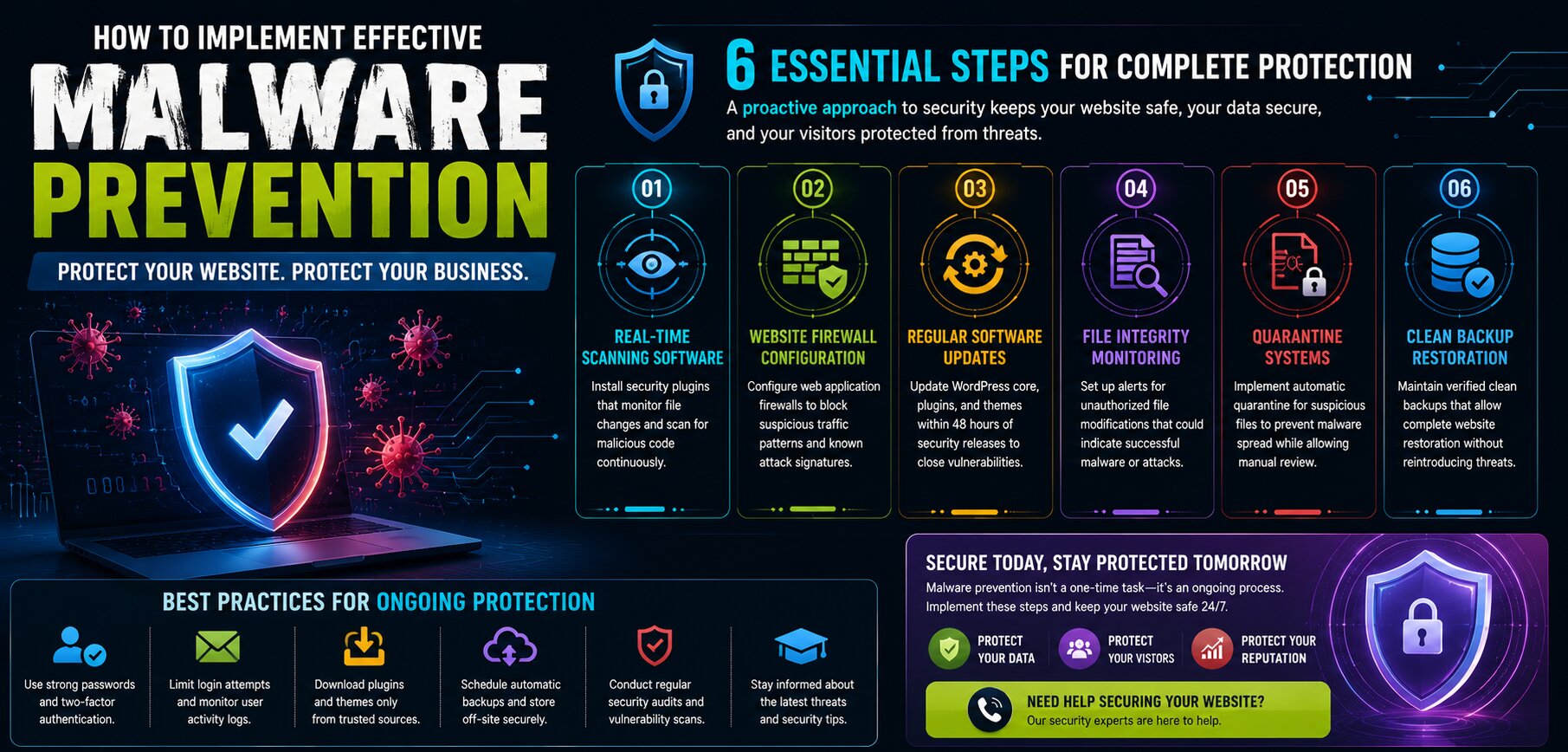
- Real-time scanning software: Install security plugins that monitor file changes and scan for malicious code continuously, not just during scheduled maintenance periods.
- Website firewall configuration: Configure web application firewalls to block suspicious traffic patterns and known attack signatures before they reach your server.
- Regular software updates: Update WordPress core, plugins, and themes within 48 hours of security releases to close known vulnerabilities immediately.
- File integrity monitoring: Set up alerts for unauthorized file modifications that could indicate successful malware installation or ongoing attacks.
- Quarantine systems: Implement automatic quarantine for suspicious files to prevent malware spread while allowing manual review of flagged content.
- Clean backup restoration: Maintain verified clean backups that allow complete website restoration without reintroducing compromised files.
Website Backup Strategies That Actually Work
Automated daily backups stored in multiple geographic locations provide the only reliable recovery method when security breaches occur. Local backups stored on the same server offer no protection against ransomware attacks that encrypt all accessible files simultaneously. According to Veeam, 58% of backups fail when businesses actually need them due to incomplete backup processes or corrupted backup files.
The 3-2-1 backup rule requires three backup copies stored on two different media types with one copy maintained offsite. Cloud storage services like Amazon S3 or Google Cloud provide geographic redundancy that protects against natural disasters affecting your primary location. SFL Media’s website management services include automated backup verification that tests restoration processes monthly.
Database backups require separate procedures from file backups because databases change constantly while websites operate. Point-in-time recovery capabilities allow restoration to specific moments before attacks occurred, minimizing data loss during security incidents.
User Access Control and Authentication Security
Multi-factor authentication (MFA) prevents 99.9% of automated attacks by requiring additional verification beyond passwords alone. Strong password policies mandate minimum 12-character passwords combining uppercase letters, lowercase letters, numbers, and special characters. Regular access audits remove unused accounts that create unnecessary entry points for potential attackers.
| User Role | Access Level | Required Authentication | Review Frequency |
|---|---|---|---|
| Administrator | Full system access | MFA + Strong password | Monthly |
| Editor | Content management only | MFA + Strong password | Quarterly |
| Author | Limited content creation | Strong password | Quarterly |
| Subscriber | View access only | Standard password | Annually |
Monitoring and Incident Response Planning
Continuous security monitoring detects attacks in progress rather than discovering breaches weeks later through customer complaints or search engine warnings. Automated alert systems notify administrators immediately when suspicious activities occur, enabling rapid response that limits damage scope. Log analysis reveals attack patterns and identifies vulnerabilities before criminals exploit them successfully.
Incident response plans outline specific steps for containing breaches, assessing damage, notifying affected parties, and restoring normal operations quickly. SFL Media’s South Florida clients with documented response procedures recover from security incidents 73% faster than businesses without formal protocols. Response plans must include communication templates for customer notifications and regulatory reporting requirements.
Regular security testing through vulnerability scans and penetration testing identifies weaknesses before attackers discover them. Professional security assessments provide objective evaluations of current protection levels and specific recommendations for improvement.
Final Thoughts on Website Security Best Practices
Website security best practices require ongoing attention and regular updates as cyber threats continue evolving throughout 2026. The businesses that survive and thrive implement layered security approaches combining technical protections with proper procedures and regular monitoring. Waiting until after an attack occurs costs significantly more than investing in comprehensive protection from the beginning.
SFL Media’s Fort Lauderdale team specializes in implementing enterprise-level security measures for South Florida businesses of all sizes. Our comprehensive approach addresses every vulnerability while maintaining website performance and user experience that drives business growth.
Protect your South Florida business with professional website security implementation. Contact our security specialists or call (954) 740-7900 for a comprehensive security assessment and customized protection plan.
Frequently Asked Questions About Website Security Best Practices
What are the most important website security measures?
SSL certificates, regular software updates, strong password policies, automated backups, and malware scanning software provide essential protection against common cyber threats. These five measures prevent 85% of successful website attacks when implemented correctly together.
How do I protect my website from hackers?
Install security plugins with real-time monitoring, enable multi-factor authentication for all user accounts, keep software updated within 48 hours of releases, and maintain verified backups stored offsite. Regular security scans identify vulnerabilities before attackers exploit them.
What is an SSL certificate and do I need one?
SSL certificates encrypt data transmitted between websites and visitors, preventing hackers from intercepting sensitive information like passwords and personal details. Every website needs SSL certification in 2026 because browsers display security warnings for unencrypted sites, causing visitors to leave immediately.
How often should I backup my website?
Daily automated backups provide adequate protection for most websites, while e-commerce sites processing frequent transactions need hourly backups to minimize potential data loss. Store backups in multiple locations using the 3-2-1 rule: three copies on two different media types with one copy maintained offsite.
What are common website security threats?
SQL injection attacks, cross-site scripting (XSS), malware infections, brute force password attacks, and outdated software vulnerabilities represent the most frequent security threats in 2026. Automated attack tools scan millions of websites daily searching for these specific vulnerabilities to exploit.