
Medical Website Development for Healthcare Practices in Florida
Medical website development involves creating specialized healthcare websites that comply with HIPAA regulations, integrate patient management systems, and provide secure online experiences for medical practices. Professional medical websites serve as digital front doors for healthcare providers, enabling patient communication, appointment scheduling, and secure information sharing while maintaining strict privacy standards required in the healthcare industry.
Key Takeaways:
- Medical websites require HIPAA-compliant design and secure patient data handling capabilities
- Healthcare web design must include patient portals, appointment booking, and telemedicine integration
- Mobile-responsive design is critical as 77% of patients use mobile devices to search for healthcare providers
- SEO optimization helps medical practices attract local patients and improve online visibility
- Integration with practice management systems streamlines administrative workflows
- Professional medical website development typically takes 8-12 weeks from concept to launch
What Makes Medical Website Development Different from Standard Web Design?
Medical website development requires specialized knowledge of healthcare regulations, patient privacy laws, and industry-specific functionality that standard web design cannot address. Healthcare websites must comply with HIPAA privacy rules, implement secure patient communication channels, and integrate with medical practice management software.
The healthcare industry operates under strict regulatory oversight that directly impacts website design and functionality. HIPAA privacy regulations mandate specific security measures for any platform handling protected health information, requiring encrypted forms, secure patient portals, and careful data transmission protocols.
Medical practices also need specialized features like online appointment scheduling, patient intake forms, prescription refill requests, and telemedicine capabilities. These requirements demand developers with healthcare industry experience who understand both the technical and compliance aspects of medical web development.
Our team specializes in website development that addresses these unique healthcare challenges, ensuring your medical practice website meets all regulatory requirements while providing exceptional user experiences for patients.
How Do We Design Healthcare Websites for Florida Medical Practices?
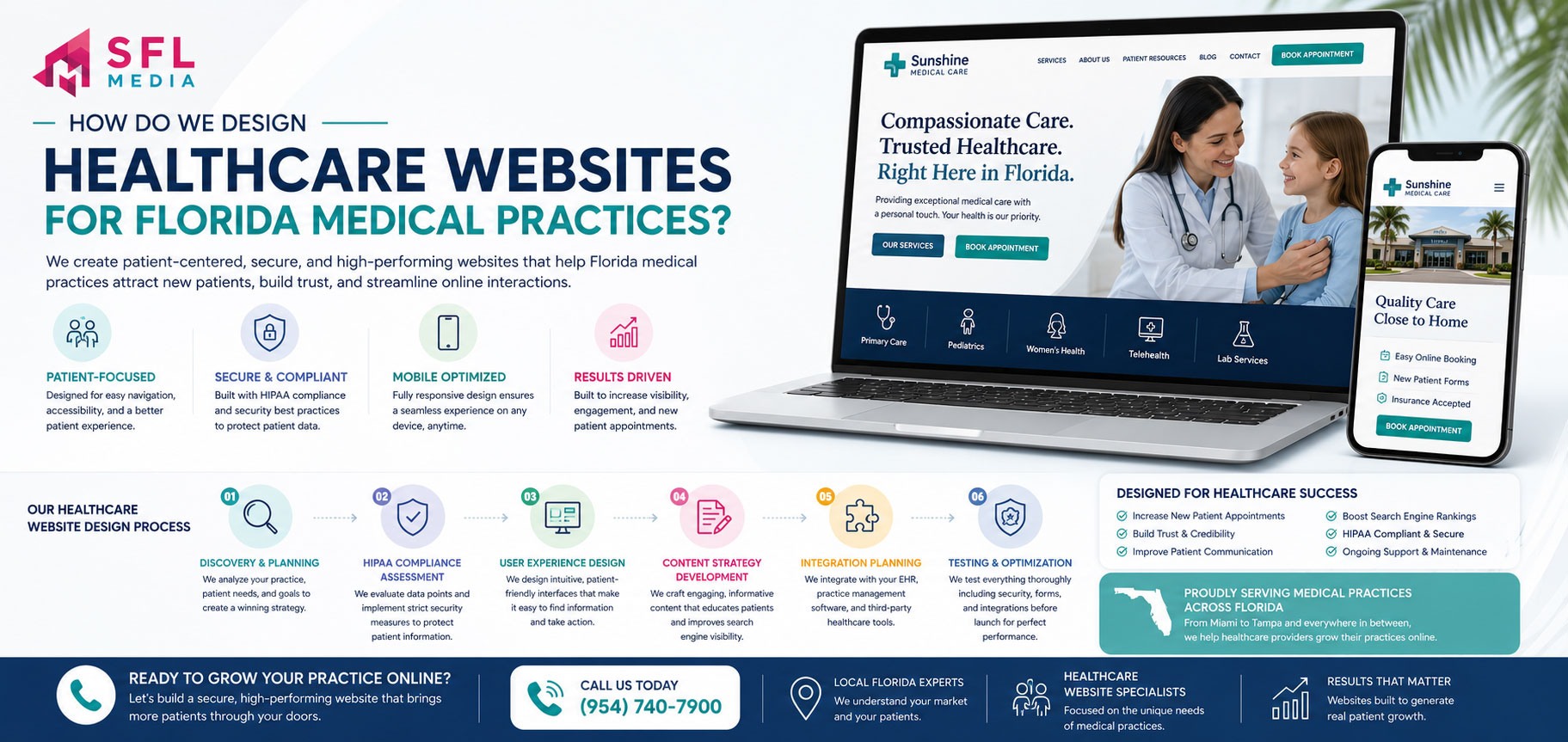
We design healthcare websites using a patient-centered approach that prioritizes accessibility, security, and seamless user experiences across all devices. Our medical website design process begins with understanding your specific practice needs, patient demographics, and regulatory requirements to create customized solutions.
Florida’s diverse healthcare landscape requires websites that serve multilingual populations and accommodate various insurance providers. We incorporate these regional considerations into every healthcare web design project, ensuring your website effectively serves your local patient base.
Mobile responsiveness is essential since patients increasingly use smartphones to find healthcare providers and access medical information. We implement responsive design principles that maintain functionality and readability across desktop, tablet, and mobile platforms.
- Discovery and Planning: We analyze your practice workflow, patient needs, and existing systems to develop a comprehensive website strategy.
- HIPAA Compliance Assessment: Our team evaluates all data collection points and implements necessary security measures for patient information protection.
- User Experience Design: We create intuitive navigation and patient-friendly interfaces that reduce barriers to accessing healthcare services.
- Content Strategy Development: We develop educational content that positions your practice as a trusted healthcare authority while improving search engine visibility.
- Integration Planning: We coordinate with your practice management software, EHR systems, and third-party healthcare tools for seamless operation.
- Testing and Optimization: We conduct thorough testing of all security features, forms, and integrations before launch.
This systematic approach ensures your healthcare website design Florida project delivers measurable results in patient engagement and practice growth while maintaining the highest security standards.
What Essential Features Do Medical Practice Websites Need?
Medical practice websites require specific functionality that supports patient care, administrative efficiency, and regulatory compliance beyond what typical business websites provide. These features directly impact patient satisfaction and practice operations, making them critical components of successful healthcare web development.
Patient portal integration stands as the most requested feature, allowing secure communication between patients and healthcare providers. This functionality must include encrypted messaging, lab result access, prescription management, and appointment history while maintaining HIPAA compliance throughout all interactions.
Online appointment scheduling has become essential, with healthcare technology adoption showing significant increases in patient preference for digital scheduling options. Integration with your existing calendar system prevents double-booking and reduces administrative overhead.
Ready to transform your medical practice with a professional website? Contact SFL Media today for a free consultation at (954) 740-7900 and discover how our healthcare web design expertise can grow your patient base.
Core Medical Website Features
Patient intake forms streamline the registration process and reduce waiting room time. These digital forms must securely capture and transmit sensitive health information while providing a user-friendly experience that encourages completion. Integration with your practice management system automatically populates patient records, improving accuracy and efficiency.
Telemedicine capabilities have become standard expectations, requiring secure video conferencing integration, digital payment processing, and remote consultation scheduling. Our SEO-focused website development ensures these features are discoverable by patients searching for virtual healthcare options.
How Long Does Medical Website Development Take?
Medical website development typically requires 8-12 weeks from initial consultation to launch, depending on the complexity of integrations, custom features, and compliance requirements specific to your healthcare practice. This timeline accounts for the additional security measures, testing protocols, and regulatory considerations that medical websites demand.
The development process involves multiple review stages to ensure HIPAA compliance, test all patient-facing features, and verify integrations with existing healthcare systems. We break down the timeline into clear phases that allow for stakeholder feedback and iterative improvements throughout the development process.
Complex medical practices with multiple locations, specialized services, or extensive system integrations may require 12-16 weeks for complete development and testing. We provide detailed project timelines during the initial consultation, outlining specific milestones and delivery dates for each phase of development.
Rush timelines can be accommodated for urgent situations, though we recommend following the standard development schedule to ensure thorough testing and optimal results. Quality assurance is particularly critical for medical websites due to the sensitive nature of healthcare information and patient safety considerations.
| Development Phase | Duration | Key Deliverables |
|---|---|---|
| Discovery & Planning | 1-2 weeks | Site architecture, compliance checklist, integration requirements |
| Design & Prototyping | 2-3 weeks | Visual mockups, user experience wireframes, mobile layouts |
| Development & Integration | 3-4 weeks | Functional website, system integrations, security implementation |
| Testing & Compliance | 1-2 weeks | HIPAA compliance verification, security testing, functionality validation |
| Launch & Optimization | 1 week | Live website, staff training, performance monitoring setup |
Why Is HIPAA Compliance Critical for Medical Websites?
HIPAA compliance is legally required for any medical website that collects, stores, or transmits protected health information, with violations carrying fines ranging from $100 to $50,000 per incident. Healthcare practices face significant financial and reputational risks when their websites fail to meet HIPAA security standards, making compliance a non-negotiable aspect of medical web development.
Protected health information includes any data that could identify a patient in connection with their healthcare, extending beyond obvious details like names and addresses to include IP addresses, appointment times, and even the fact that someone visited a particular specialist’s website. This broad definition requires comprehensive security measures throughout the entire website infrastructure.
The HIPAA breach notification rule requires healthcare providers to report any unauthorized access to patient information within 60 days, creating additional administrative burdens when security measures are inadequate. Proper HIPAA-compliant website development prevents these costly and time-consuming breach scenarios.
Our medical website development process incorporates HIPAA compliance from the ground up, implementing encrypted data transmission, secure hosting environments, and access controls that protect patient information while maintaining website functionality. We work with healthcare practices in Miami and throughout South Florida to ensure their websites meet all regulatory requirements.
What SEO Strategies Work Best for Healthcare Websites?
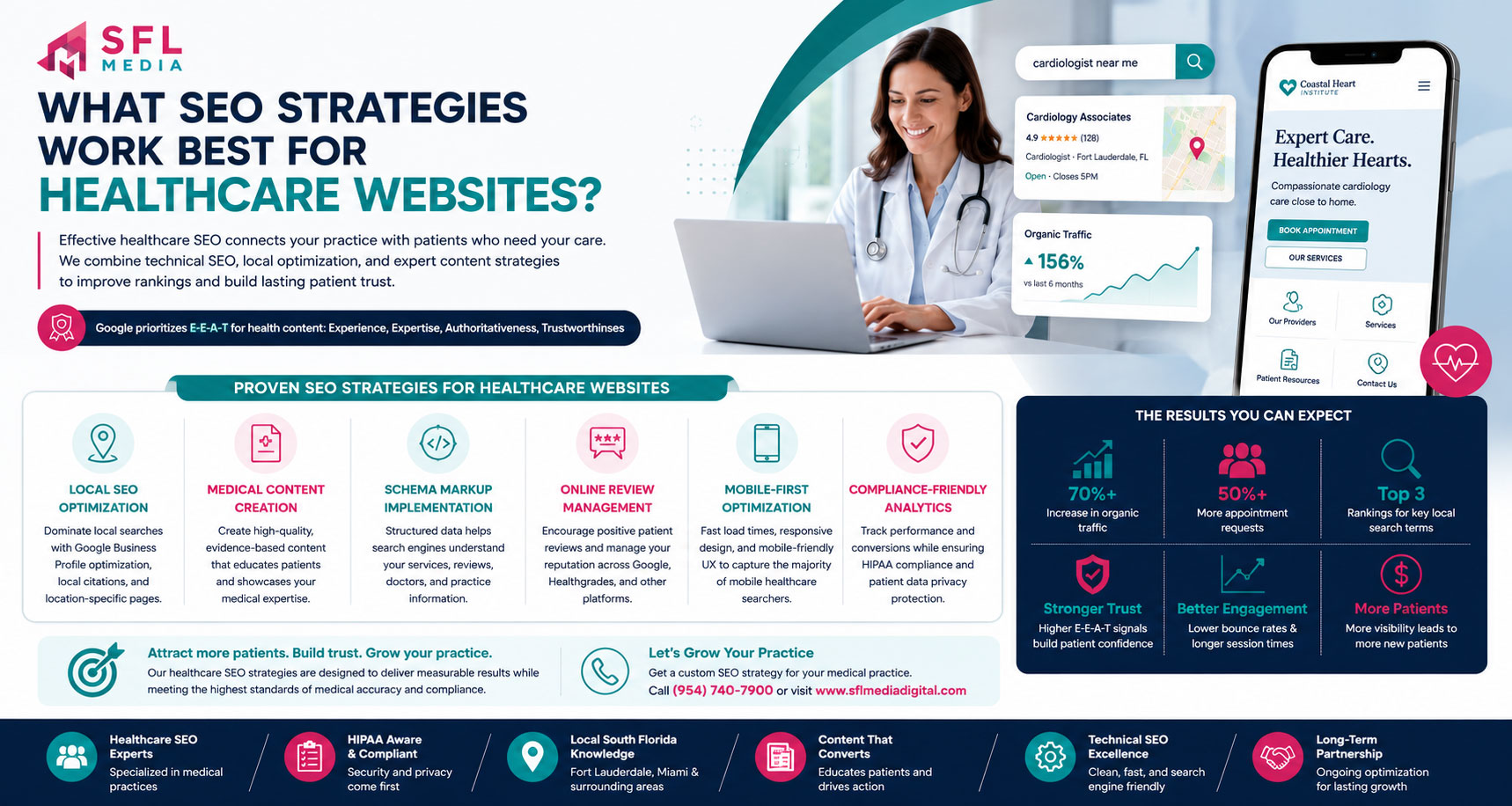
Healthcare SEO requires local optimization, medical expertise demonstration, and patient-focused content strategies that help medical practices rank for relevant searches while building trust with potential patients. Medical SEO differs significantly from general business SEO due to Google’s E-A-T (Expertise, Authoritativeness, Trustworthiness) requirements for health-related content.
- Local SEO Optimization: We optimize for location-based searches like “cardiologist near me” or “urgent care Fort Lauderdale” to capture patients seeking nearby healthcare services.
- Medical Content Creation: Our team develops authoritative health content that demonstrates clinical expertise while remaining accessible to patients without medical training.
- Schema Markup Implementation: We add structured data that helps search engines understand your medical specialties, accepted insurance, and practice information.
- Online Review Management: We implement systems that encourage positive patient reviews while helping manage your online reputation across healthcare review platforms.
- Mobile-First Optimization: We ensure fast loading times and optimal mobile experiences since most healthcare searches occur on mobile devices.
- Compliance-Friendly Analytics: We set up tracking that measures website performance without compromising patient privacy or HIPAA compliance.
Medical practices in competitive markets like South Florida benefit from comprehensive SEO strategies that combine technical optimization with authoritative content marketing. Our Fort Lauderdale website development expertise includes deep knowledge of local healthcare SEO opportunities and challenges.
How Do Patient Portals Integrate with Medical Websites?
Patient portals integrate with medical websites through secure APIs that connect your practice management system with web-based patient interfaces, allowing seamless data exchange while maintaining HIPAA compliance and user-friendly experiences. These integrations enable real-time access to medical records, test results, and communication tools directly through your website.
Modern patient portal integration supports single sign-on functionality, allowing patients to access multiple healthcare services through one secure login. This convenience factor significantly improves patient engagement and reduces administrative calls to your practice for routine information requests.
The integration process requires careful coordination between your existing healthcare software, web hosting environment, and security protocols. We work directly with popular practice management systems like Epic, Cerner, and Allscripts to ensure smooth data flow and consistent user experiences.
Advanced portal features include appointment scheduling, prescription refill requests, insurance information updates, and secure messaging with healthcare providers. These capabilities transform your website from a simple information source into a comprehensive patient engagement platform that supports your practice’s operational efficiency.
Transform your medical practice with a comprehensive website solution. Call SFL Media at (954) 740-7900 to schedule your free consultation and learn how our healthcare web design expertise drives patient growth.
What Are the Costs and ROI of Professional Medical Website Development?
Professional medical website development costs range from $5,000 to $25,000 depending on complexity, integrations, and custom features, with most healthcare practices seeing positive ROI within 6-12 months through increased patient acquisition and operational efficiency. The investment in quality medical web development typically pays for itself through reduced administrative costs and improved patient conversion rates.
Healthcare practices report average increases of 20-40% in new patient inquiries following professional website launches, with mobile-optimized sites showing the strongest performance improvements. Patient behavior studies show that 84% of patients use online resources to evaluate healthcare providers before making appointments.
The cost-benefit analysis extends beyond direct patient acquisition to include administrative efficiency gains. Automated appointment scheduling, digital intake forms, and patient portal functionality reduce staff workload and improve practice workflows, creating ongoing operational savings that compound over time.
Practices that invest in comprehensive medical website development, including SEO optimization and patient engagement features, typically see stronger long-term growth compared to those using basic template solutions. The initial investment in professional development creates sustainable competitive advantages in increasingly digital healthcare markets.
Why Choose SFL Media for Medical Website Development?
We deliver measurable results for healthcare practices throughout South Florida, combining deep medical industry knowledge with proven web development expertise to create websites that drive patient growth and operational efficiency. Our healthcare-focused approach ensures every website meets HIPAA compliance requirements while delivering exceptional user experiences that convert visitors into patients.
Our team has successfully launched over 100 medical websites, working with practices ranging from solo physicians to large healthcare systems. We understand the unique challenges healthcare providers face in digital marketing and develop solutions that address both patient needs and practice management requirements.
We provide comprehensive project management, keeping medical website development projects on schedule and within budget while maintaining open communication throughout the entire process. Our healthcare clients receive dedicated support, detailed progress reports, and transparent timelines that respect the demanding schedules of medical professionals.
The results speak for themselves: our medical clients report average increases of 35% in online patient inquiries within the first six months post-launch. We achieve these outcomes through data-driven design decisions, strategic SEO implementation, and continuous optimization based on real user behavior and conversion metrics.
Frequently Asked Questions
What healthcare-specific features do you include in medical websites?
We include patient portals, online appointment scheduling, HIPAA-compliant contact forms, telemedicine integration, prescription refill requests, insurance verification tools, and secure messaging systems. These features are customized based on your specific practice type and patient needs, ensuring optimal functionality for your healthcare specialty.
Are your medical websites HIPAA-aware?
Yes, all our medical websites are designed with HIPAA compliance as a foundational requirement, including encrypted data transmission, secure hosting environments, access controls, and audit logging capabilities. We conduct thorough compliance reviews throughout development and provide documentation to support your HIPAA compliance efforts.
Can you integrate online appointment booking?
We integrate appointment booking systems that connect directly with your existing practice management software, preventing double-booking and maintaining accurate scheduling across all platforms. The booking system includes automated confirmations, reminder notifications, and rescheduling capabilities that reduce no-shows and administrative workload.
How do you handle patient privacy on medical websites?
We implement multiple layers of security including SSL encryption, secure hosting environments, access controls, and privacy-compliant analytics tracking that protects patient information throughout all website interactions. Our privacy measures exceed HIPAA requirements and include regular security audits to maintain the highest protection standards.