
Restaurant Website Design South Florida
Restaurant website design creates custom digital platforms that showcase menus, enable online ordering, and drive customer reservations for food service businesses. Our restaurant web developers in South Florida build responsive websites that integrate seamlessly with point-of-sale systems, delivery platforms, and reservation management tools. These specialized websites convert hungry visitors into paying customers through strategic design and restaurant-focused functionality.
Key Takeaways:
- Restaurant websites require specialized features like online ordering, menu displays, and reservation systems
- Mobile-responsive design is critical since 60% of restaurant searches happen on smartphones
- Integration with delivery platforms and POS systems streamlines operations and increases revenue
- Local SEO optimization helps restaurants appear in “near me” searches and Google Maps results
- Professional food photography and visual design directly impact customer ordering decisions
- Fast loading speeds are essential as restaurant customers expect immediate access to menus and ordering
What Features Should Restaurant Websites Include?
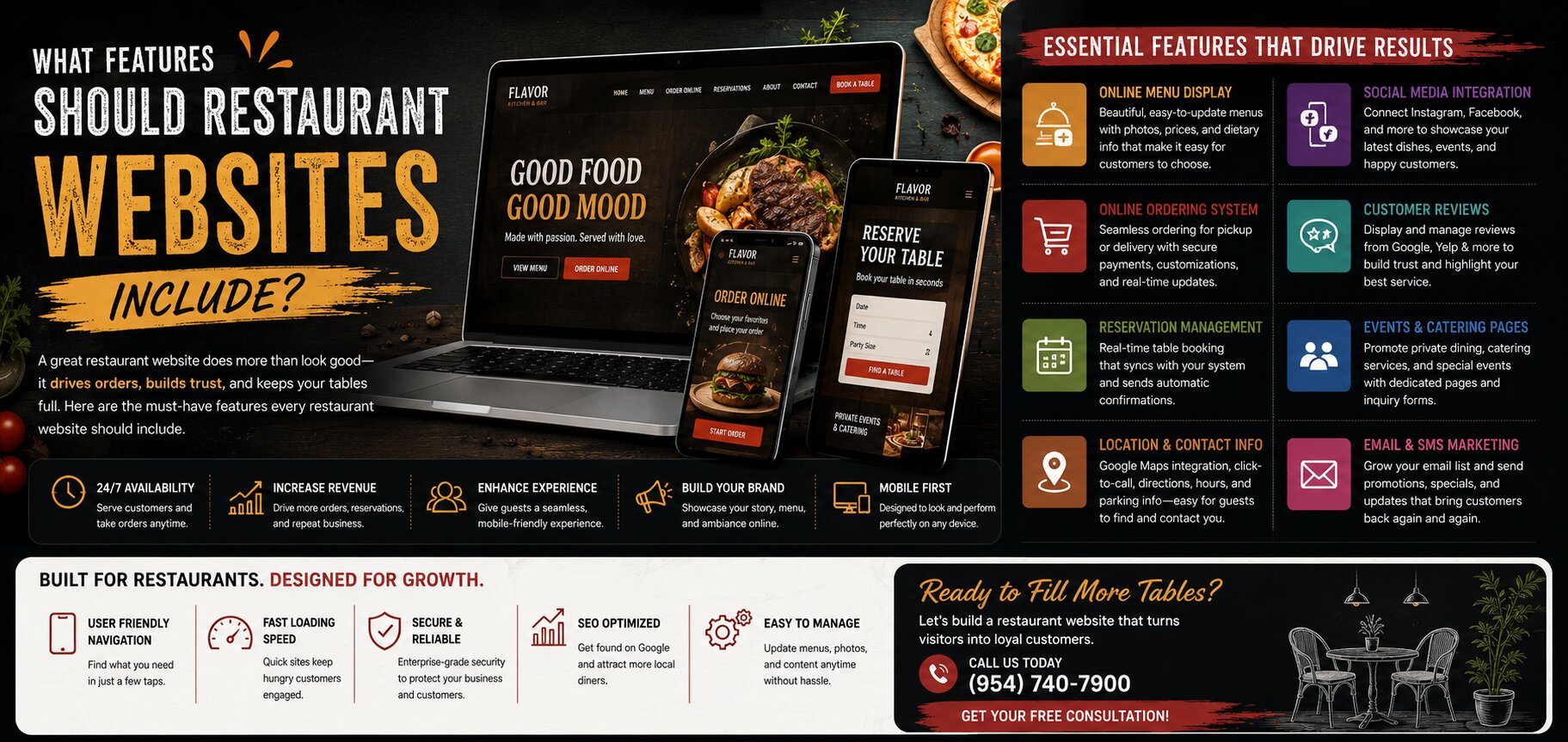
Restaurant websites must include core functionality that addresses customer needs and business operations simultaneously. Essential features include online menu displays, contact information, location details, hours of operation, and reservation capabilities. These elements work together to provide customers with the information they need to make dining decisions quickly.
Modern restaurant websites serve as digital storefronts that operate 24/7, allowing customers to browse menus, place orders, and make reservations outside of business hours. The website becomes an extension of the physical restaurant experience, setting expectations for food quality, atmosphere, and service level through visual design and content presentation.
Our restaurant web design Florida approach prioritizes user experience optimization to reduce friction in the customer journey from initial visit to completed order or reservation. We focus on clear navigation, prominent call-to-action buttons, and intuitive menu organization that mirrors how customers naturally search for food options.
The integration capabilities of restaurant websites determine their long-term value for business operations. Websites that connect with existing systems reduce manual work and improve accuracy in order management, customer communication, and inventory tracking.
- Online Menu Display: Interactive menus with high-quality food photography, detailed descriptions, pricing, and dietary restriction indicators that update automatically across all platforms.
- Online Ordering System: Integrated e-commerce functionality for takeout and delivery orders with payment processing, order customization options, and estimated pickup times.
- Reservation Management: Real-time table booking system that syncs with restaurant scheduling software and sends automated confirmation emails to customers.
- Location and Contact Integration: Embedded Google Maps, click-to-call phone numbers, and driving directions with parking information for easy customer access.
- Social Media Integration: Live feeds from Instagram and Facebook showcasing daily specials, events, and customer experiences to build social proof.
- Customer Reviews Display: Integration with Google Reviews, Yelp, and other platforms to showcase positive feedback and respond to customer concerns publicly.
- Event and Catering Pages: Dedicated sections for private dining, catering services, and special events with inquiry forms and pricing information.
We build these features using scalable architecture that grows with restaurant operations, ensuring the website remains functional as businesses expand locations or add new service offerings.
How Does Mobile Optimization Impact Restaurant Success?
Mobile optimization directly impacts restaurant revenue since approximately 60% of restaurant searches occur on smartphones, with customers expecting immediate access to menus, locations, and ordering capabilities. Restaurants with mobile-optimized websites capture more spontaneous dining decisions and last-minute orders compared to competitors with desktop-only experiences.
The mobile experience determines whether potential customers complete their intended actions or abandon the website for competitors. Restaurant customers using mobile devices are typically in high-intent situations – they’re hungry now and need quick access to information or ordering capabilities without delays or frustrating navigation.
Our food business website development process prioritizes mobile-first design, ensuring all functionality works seamlessly on smartphones and tablets before adapting to desktop screens. This approach reflects actual user behavior patterns and improves conversion rates across all devices.
Mobile optimization extends beyond responsive design to include features like one-touch calling, GPS integration for directions, and streamlined checkout processes that work with mobile payment systems like Apple Pay and Google Pay.
Ready to create a mobile-optimized restaurant website that drives orders and reservations? Contact our restaurant web developers at (954) 740-7900 for a free consultation and discover how we can increase your digital revenue.
Restaurant Website Design vs Template Solutions
Custom restaurant website design provides specialized functionality and brand differentiation that generic templates cannot match, particularly for integration with restaurant-specific systems and local market positioning. While templates offer lower upfront costs, they limit customization options and often require expensive modifications to achieve restaurant-specific functionality.
The restaurant industry requires unique features that general business templates don’t accommodate effectively. Menu management, online ordering workflows, reservation systems, and delivery platform integrations need custom development to work seamlessly with existing restaurant operations.
Our custom approach allows for brand storytelling through design elements that reflect restaurant atmosphere, cuisine type, and target customer demographics. This visual consistency between the website and physical location builds customer expectations and improves satisfaction when they visit in person.
| Feature | Custom Design | Template Solution |
|---|---|---|
| Menu Integration | Dynamic menus with POS sync | Static menu pages |
| Online Ordering | Custom workflow with kitchen integration | Third-party plugins only |
| Brand Consistency | Complete visual customization | Limited color and font options |
| Loading Speed | Optimized code for restaurant needs | Bloated with unnecessary features |
| SEO Optimization | Restaurant-specific local SEO | Generic SEO structure |
| Ongoing Support | Dedicated restaurant expertise | General technical support |
How Do You Integrate Online Ordering Systems?
Online ordering integration connects restaurant websites directly with kitchen operations, payment processing, and customer communication systems to create seamless order management from placement to fulfillment. We develop custom APIs that sync with existing point-of-sale systems, ensuring orders flow automatically into kitchen workflows without manual data entry or potential errors.
The integration process begins with analyzing current restaurant operations to identify the most efficient connection points between the website and existing systems. We map customer ordering workflows to match kitchen capabilities, delivery zones, and staffing patterns to prevent operational bottlenecks during peak ordering periods.
Our e-commerce development expertise extends to restaurant-specific requirements like order timing controls, inventory management, and dynamic pricing for different service types. The system automatically adjusts availability based on kitchen capacity and ingredient stock levels.
Payment processing integration includes multiple options for customer convenience while maintaining PCI compliance and fraud protection. We implement secure payment gateways that handle credit cards, digital wallets, and gift card redemption through encrypted transactions.
- POS System Connection: Direct integration with Square, Toast, or other restaurant POS systems to sync menus, pricing, and inventory automatically without manual updates.
- Kitchen Display Integration: Orders appear on kitchen display systems with preparation timing, special instructions, and order priority based on promised delivery times.
- Delivery Platform Sync: Simultaneous order management across DoorDash, Uber Eats, and direct website orders through centralized dashboard systems.
- Customer Communication: Automated order confirmations, preparation updates, and ready notifications via SMS and email with real-time status tracking.
- Inventory Management: Real-time menu item availability updates based on ingredient levels and daily prep quantities to prevent overselling.
We test all integrations thoroughly before launch to ensure order accuracy and system reliability during high-volume periods like lunch rushes and weekend dinner service.
What Makes Restaurant SEO Different?
Restaurant SEO focuses heavily on local search optimization since customers typically search for nearby dining options using location-based queries and “near me” searches. Unlike general business SEO, restaurant optimization must target hyper-local keywords, manage multiple location listings, and optimize for voice search queries that customers use when looking for immediate dining solutions.
The restaurant industry benefits significantly from Google My Business optimization, review management, and local citation consistency across directory platforms. Studies show that 87% of consumers read online reviews for local businesses, making reputation management a critical component of restaurant SEO strategy.
Our SEO-focused website development incorporates schema markup specifically for restaurants, including menu items, price ranges, cuisine types, and operating hours. This structured data helps search engines understand restaurant offerings and display rich snippets in search results.
Local Search Optimization
Local search optimization for restaurants requires consistent NAP (Name, Address, Phone) information across all online platforms, from the website to social media profiles and directory listings. We audit existing online presence to identify and correct inconsistencies that confuse search engines and potential customers.
Review and Reputation Management
Review management integration allows restaurants to monitor and respond to customer feedback across multiple platforms from a centralized dashboard. We implement systems that encourage satisfied customers to leave reviews while providing tools to address negative feedback professionally and promptly.
How Long Does Restaurant Website Development Take?
Restaurant website development typically takes 6-10 weeks from initial consultation to launch, depending on the complexity of integrations and custom features required. This timeline includes discovery, design, development, integration testing, and staff training phases to ensure the website supports restaurant operations effectively from day one.
The development process begins with a detailed analysis of current restaurant operations, existing technology systems, and customer service workflows. We spend 1-2 weeks in discovery to understand menu complexity, service types, and integration requirements before beginning design work.
Design and development phases run 4-6 weeks and include regular check-ins with restaurant management to ensure the website aligns with brand vision and operational needs. We build functionality in phases, allowing for testing and refinement of critical features like online ordering and reservation systems.
Integration testing requires 1-2 weeks to ensure all systems communicate properly and handle realistic order volumes without errors. We simulate peak ordering periods and test failure scenarios to identify potential issues before launch.
- Discovery and Planning (1-2 weeks): Restaurant operations analysis, technology audit, competitor research, and project scope definition with detailed timeline and milestone planning.
- Design Phase (2-3 weeks): Brand analysis, visual design creation, user experience mapping, and mobile optimization planning with client feedback and revision cycles.
- Development Phase (3-4 weeks): Custom coding, CMS setup, integration development, and feature implementation with weekly progress reviews and testing.
- Integration Testing (1-2 weeks): POS system connections, payment processing setup, delivery platform integration, and stress testing under simulated peak conditions.
- Launch and Training (1 week): Final deployment, staff training sessions, documentation delivery, and post-launch monitoring to ensure smooth operations.
We provide ongoing support and maintenance to address any issues and implement updates as restaurant operations evolve or expand to new locations.
Start your restaurant website project today with South Florida’s leading food business developers. Call (954) 740-7900 to schedule your free consultation and get a detailed timeline for your specific requirements.
What Photography and Visual Elements Work Best?
High-quality food photography serves as the primary conversion driver for restaurant websites, with professional images increasing online order values by an average of 30% compared to amateur photography. Visual elements must showcase food quality, portion sizes, and presentation style while maintaining consistent lighting and styling that reflects the restaurant’s actual offerings.
The visual hierarchy of restaurant websites guides customers through the decision-making process, from initial appetite appeal through menu exploration to order completion. We design layouts that feature hero images of signature dishes, create visual separation between menu categories, and use color psychology to encourage specific customer actions.
Our design process includes art direction for food photography sessions, ensuring images work effectively across all device sizes and loading speeds. We optimize images for web performance while maintaining the visual quality necessary to represent food attractively.
Brand consistency through visual elements builds customer recognition and trust, particularly for restaurants with multiple locations or franchise operations. We develop visual style guides that maintain consistency across websites, social media, and print materials.
How Do You Handle Multi-Location Restaurant Chains?
Multi-location restaurant websites require centralized content management with location-specific customization for menus, pricing, hours, and local promotions. We build scalable architectures that allow corporate management to maintain brand consistency while giving individual locations flexibility to address local market needs and operational differences.
The technical infrastructure for chain restaurants includes centralized user management, shared design templates, and automated content distribution systems. Location managers can update specific information like hours, staff, and local events without affecting other locations or requiring technical expertise.
SEO strategy for multi-location restaurants focuses on creating individual location pages optimized for local search while maintaining domain authority through the main corporate website. Each location receives dedicated pages with unique content, local business schema markup, and integration with location-specific Google My Business profiles.
Our website development approach scales efficiently as chains add new locations, with streamlined onboarding processes that can launch new location pages within days rather than weeks.
- Centralized Content Management: Corporate-level control over brand messaging, core menu items, and promotional campaigns with location-specific override capabilities for pricing and availability.
- Location-Specific SEO: Individual landing pages for each location with unique content, local keyword optimization, and integration with local directory listings and review platforms.
- Unified Online Ordering: Single ordering system that automatically routes orders to appropriate locations based on customer address while maintaining consistent user experience across all locations.
- Franchise Management Tools: Dashboard systems for franchise owners to manage their location’s online presence, monitor performance metrics, and access corporate marketing materials.
- Performance Analytics: Location-specific reporting that allows comparison between sites, identification of high-performing content, and optimization opportunities for individual markets.
We provide training and documentation for both corporate teams and individual location managers to ensure effective use of all website features and management tools.
Why Choose SFL Media for Restaurant Website Design
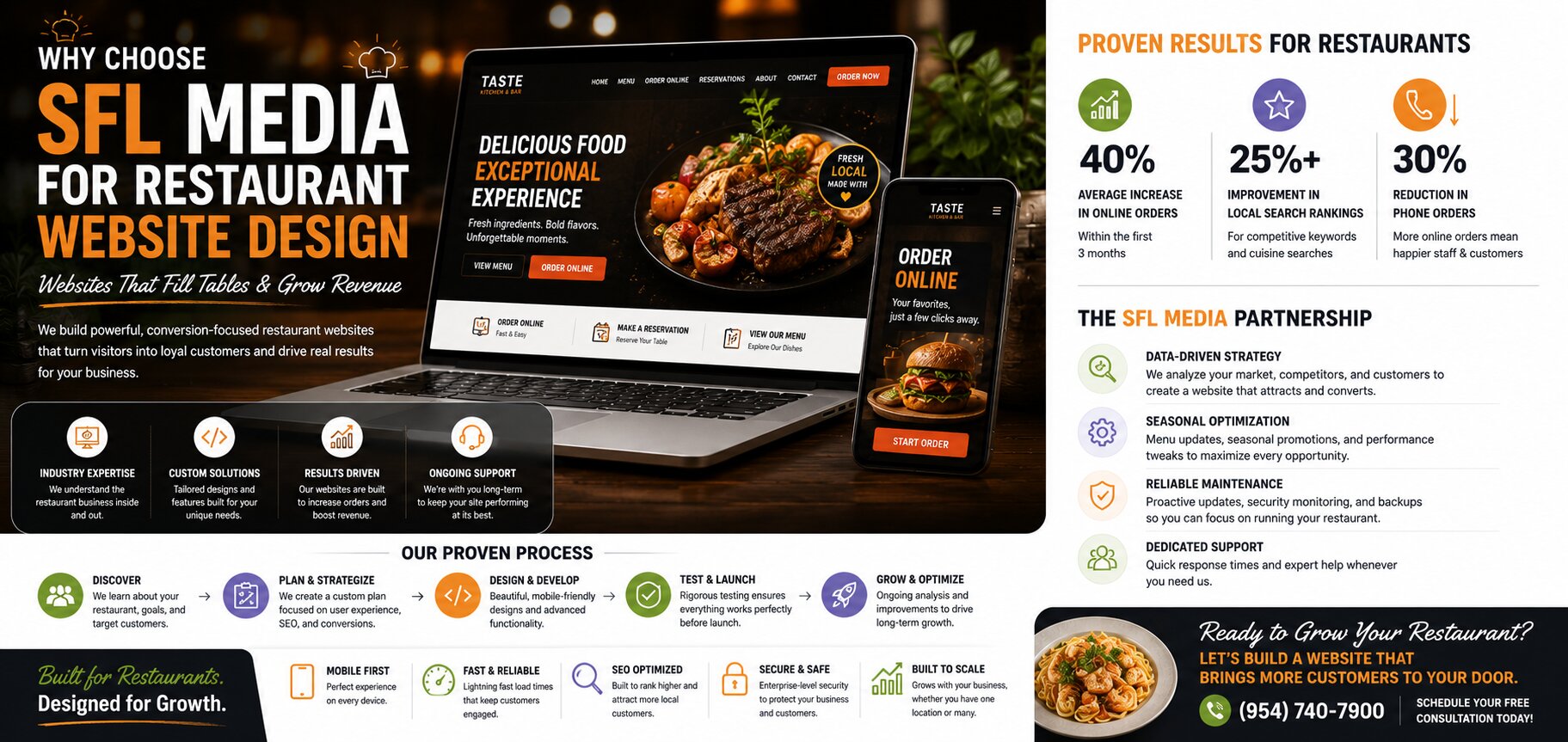
SFL Media combines deep restaurant industry knowledge with advanced web development expertise to create websites that drive measurable business results for South Florida food service businesses. Our team understands the unique challenges restaurants face in digital marketing, from seasonal menu changes to peak ordering periods, and builds solutions that support operational efficiency while maximizing online revenue.
We have successfully launched restaurant websites that achieved average increases of 40% in online orders within the first three months and improved local search rankings for competitive keywords like “best restaurants near me” and cuisine-specific searches. Our clients report reduced phone order volume as customers prefer the convenience of online ordering, freeing staff to focus on food preparation and in-person customer service.
Our ongoing partnership approach includes regular performance analysis, seasonal optimization updates, and proactive maintenance to ensure websites continue performing effectively as search algorithms and customer expectations evolve. We monitor site speed, conversion rates, and search rankings monthly, making data-driven improvements that compound over time.
The combination of technical expertise and restaurant industry focus allows us to anticipate challenges and implement solutions that generic web developers often miss. From handling Mother’s Day traffic spikes to integrating with specialized restaurant software, we provide comprehensive support that keeps websites running smoothly during critical business periods.
Frequently Asked Questions
What features should a restaurant website include?
Restaurant websites should include online menu displays, reservation systems, online ordering capabilities, contact information, location details, and integration with delivery platforms. Additional valuable features include customer reviews, social media feeds, event information, and mobile-optimized design for smartphone users who represent the majority of restaurant website traffic.
Can you integrate online ordering or delivery platforms?
Yes, we integrate online ordering systems directly with restaurant POS systems and connect with major delivery platforms like DoorDash, Uber Eats, and Grubhub. Our integrations allow centralized order management, automatic menu syncing, and real-time inventory updates across all platforms. We also build custom ordering systems for restaurants that prefer direct customer relationships without third-party commission fees.
Do you include online reservation systems?
We integrate professional reservation systems that sync with restaurant scheduling software and provide real-time table availability. The system sends automated confirmation emails, reminder notifications, and allows customers to modify or cancel reservations online. Restaurant staff receive dashboard access to manage bookings, track customer preferences, and optimize table turnover during peak periods.
How do you handle restaurant local SEO?
Restaurant local SEO focuses on optimizing Google My Business profiles, managing online reviews, and creating location-specific content that targets “near me” searches. We implement restaurant-specific schema markup, optimize for voice search queries, and ensure consistent NAP information across all online directories. Local SEO strategies also include managing multiple location listings for restaurant chains and monitoring local search ranking performance.