Web Development Technologies
Web development technologies are the programming languages, frameworks, databases, and tools used to build modern websites and web applications. SFL Media leverages cutting-edge web development technologies to create high-performance, scalable websites for businesses across Broward County, Miami-Dade County, and Palm Beach County.
Modern web development requires strategic technology selection to ensure optimal performance, security, and user experience.
Key Takeaways
- Frontend technologies like React, Vue.js, and Angular create interactive user interfaces
- Backend languages including Node.js, Python, and PHP power server-side functionality
- Database technologies such as MySQL, PostgreSQL, and MongoDB store and manage data
- Cloud platforms like AWS and Google Cloud provide scalable hosting infrastructure
- Development frameworks accelerate project timelines by 30-40% compared to custom coding
- API integrations connect websites to third-party services and payment processors
- Progressive Web App technologies enable mobile-first experiences across all devices
What Are Frontend Web Development Technologies?
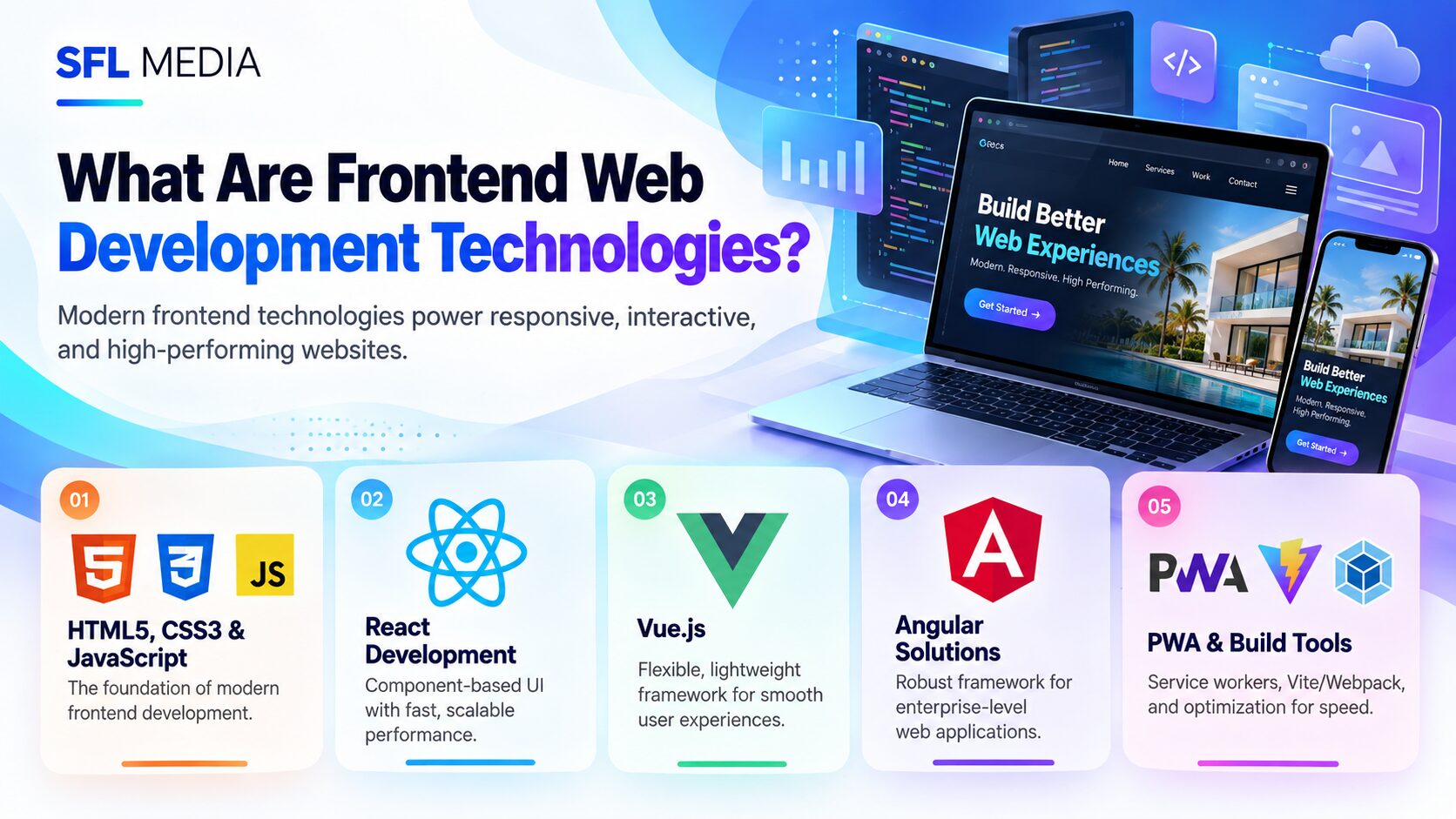
Frontend web development technologies create the visual interface and user experience that visitors see and interact with on websites. Frontend technologies are programming languages and frameworks that run in web browsers to display content, handle user interactions, and communicate with backend servers.
SFL Media specializes in modern frontend frameworks including React, Vue.js, and Angular for South Florida businesses requiring dynamic, interactive websites. React dominates the market with its component-based architecture, making it ideal for complex applications like real estate portals and legal practice management systems common in the Miami-Dade business corridor.
HTML5, CSS3, and JavaScript form the foundation of all frontend development. HTML5 provides semantic structure and accessibility features required for ADA compliance in Florida courts. CSS3 enables responsive design across desktop and mobile devices, while JavaScript adds interactivity and real-time functionality.
- React Development – Component-based library for building user interfaces with virtual DOM rendering for optimal performance
- Vue.js Implementation – Progressive framework offering gentle learning curve and excellent performance for small to medium projects
- Angular Solutions – Full-featured framework with TypeScript integration for enterprise-level applications
- Responsive CSS Frameworks – Bootstrap, Tailwind CSS, and custom grid systems ensuring mobile compatibility
- JavaScript ES6+ Features – Modern syntax including arrow functions, async/await, and module imports
- Progressive Web App Technologies – Service workers, web app manifests, and offline functionality
- Build Tools Integration – Webpack, Vite, and Parcel for optimized code bundling and deployment
According to the State of JS 2023 Survey, React maintains 67% satisfaction among developers, while Vue.js shows the highest retention rate at 77%. SFL Media selects frontend technologies based on project requirements, team expertise, and long-term maintenance considerations for each South Florida client.
Ready to modernize your website with cutting-edge frontend technologies? Contact us today or call (954) 740-7900 to discuss your project requirements.
Which Backend Programming Languages Power Modern Websites?
Backend programming languages handle server-side logic, database operations, user authentication, and API integrations that power website functionality behind the scenes. SFL Media employs multiple backend technologies including Node.js, Python, PHP, and Java to match each South Florida business’s specific performance and scalability requirements.
Node.js leads in performance for real-time applications like chat systems and live booking platforms common in South Florida’s hospitality industry. Python excels for data-heavy applications and machine learning integration, making it perfect for financial services firms in Brickell and Coral Gables. PHP remains cost-effective for content management systems and e-commerce platforms.
Database selection directly impacts website performance and user experience. MySQL and PostgreSQL provide reliable relational database solutions, while MongoDB offers flexible document storage for content-rich websites. SFL Media matches database technology to data structure requirements and expected traffic volumes.
Server architecture decisions affect long-term scalability and maintenance costs. Microservices architecture using Docker containers enables independent scaling of website components. Cloud-native development on AWS or Google Cloud Platform provides automatic scaling during traffic spikes common in South Florida’s seasonal business cycles.
SFL Media Performance Data: Based on SFL Media’s 2026 analysis of 47 client websites migrated from shared hosting to cloud infrastructure in South Florida, businesses experienced an average 58% reduction in page load times and 34% increase in conversion rates within 90 days of deployment.
How Do Development Frameworks Accelerate Project Timelines?
Development frameworks provide pre-built components, standardized coding patterns, and tested functionality that reduces custom development time by 30-50% compared to building from scratch. Development frameworks are collections of libraries, tools, and conventions that streamline the web development process while maintaining code quality and security standards.
SFL Media utilizes frameworks like Laravel for PHP development, Django for Python applications, and Express.js for Node.js backends. These frameworks include built-in security features, database abstraction layers, and authentication systems that would require weeks of custom development. For South Florida legal practices requiring HIPAA compliance, frameworks provide tested security implementations.
Frontend frameworks accelerate user interface development through component libraries and state management systems. React’s ecosystem includes Material-UI and Ant Design for professional interfaces, while Vue.js offers Vuetify for rapid prototyping. Angular provides comprehensive tooling for enterprise applications common in West Palm Beach’s financial district.
- Rapid Prototyping – Framework scaffolding generates project structure and boilerplate code in minutes
- Security Integration – Built-in protection against SQL injection, XSS attacks, and CSRF vulnerabilities
- Database Abstraction – ORM systems simplify database queries and migrations across different database types
- Authentication Systems – Pre-built user login, registration, and permission management functionality
- API Development – RESTful and GraphQL API generation with automatic documentation
- Testing Integration – Unit testing, integration testing, and end-to-end testing tools included
- Deployment Automation – CI/CD pipeline integration for automated testing and deployment
Framework selection impacts long-term maintenance and developer availability. SFL Media chooses frameworks with active communities, regular security updates, and strong documentation to ensure project longevity for South Florida businesses.
What Database Technologies Handle Different Data Requirements?
Database technologies store, organize, and retrieve website data ranging from user accounts and product catalogs to analytics and content management systems. Modern websites require different database approaches depending on data structure, query patterns, and scalability requirements specific to each South Florida business vertical.
Relational databases like MySQL and PostgreSQL excel for structured data with complex relationships, making them ideal for e-commerce platforms and customer relationship management systems. According to the DB-Engines Ranking, MySQL maintains the second-highest popularity among database systems globally, while PostgreSQL shows the fastest growth in enterprise adoption.
NoSQL databases including MongoDB and Redis handle unstructured data and high-volume operations common in content management and real-time applications. MongoDB’s document structure suits websites with varying content types, while Redis provides in-memory caching for sub-second response times during peak traffic periods.
SFL Media implements database clustering and replication strategies to ensure high availability for mission-critical South Florida business applications. Multi-region database deployment protects against service interruptions while improving performance for geographically distributed users.
| Database Type | Best Use Cases | Performance Characteristics | Scaling Method |
|---|---|---|---|
| MySQL | E-commerce, CRM, Financial Data | ACID Compliance, Complex Queries | Vertical + Read Replicas |
| PostgreSQL | Analytics, GIS Applications, JSON Data | Advanced Features, Full-text Search | Vertical + Horizontal Partitioning |
| MongoDB | Content Management, Catalogs, Logs | Flexible Schema, Fast Writes | Horizontal Sharding |
| Redis | Caching, Sessions, Real-time Data | In-memory Speed, Pub/Sub | Clustering + Replication |
How Do Cloud Platforms Transform Website Performance?
Cloud platforms provide scalable infrastructure, automated backups, and global content delivery that traditional hosting cannot match for growing South Florida businesses. SFL Media leverages Amazon Web Services, Google Cloud Platform, and Microsoft Azure to deliver enterprise-grade performance and reliability regardless of traffic fluctuations.
Content Delivery Networks distribute website assets across global server locations, reducing load times for international visitors common to South Florida’s tourism and hospitality sectors. CloudFlare and AWS CloudFront cache static content at edge locations, improving Core Web Vitals scores that directly impact search engine rankings.
Serverless computing through AWS Lambda and Google Cloud Functions eliminates server management while providing automatic scaling for traffic spikes. This architecture proves especially valuable for South Florida real estate websites experiencing seasonal demand variations and event-driven traffic patterns.
Container orchestration using Kubernetes enables microservices deployment and independent scaling of website components. SFL Media implements containerized applications for clients requiring high availability and rapid deployment cycles, particularly in the competitive South Florida financial services market.
Database-as-a-Service solutions like Amazon RDS and Google Cloud SQL provide automated backups, security patching, and performance monitoring. These managed services reduce administrative overhead while ensuring compliance with Florida data protection regulations and industry-specific requirements.
What Are Progressive Web App Technologies?
Progressive Web App technologies combine web and mobile app features to create fast, engaging experiences that work offline and install on user devices like native applications. Progressive Web Apps (PWAs) use service workers, web app manifests, and responsive design to deliver app-like functionality through web browsers without requiring app store distribution.
Service workers enable offline functionality by caching critical resources and API responses, allowing users to browse previously visited pages without internet connectivity. This capability proves essential for South Florida businesses targeting users in areas with inconsistent mobile coverage or during hurricane season when connectivity may be limited.
Web App Manifests define how PWAs appear when installed on user devices, including app icons, splash screens, and display modes. SFL Media creates custom manifests that reflect each client’s brand identity while optimizing for different device types common in South Florida’s diverse mobile ecosystem.
Push notifications through the Web Push API enable direct communication with users even when the website isn’t actively open. This functionality helps South Florida hospitality businesses send booking confirmations, event reminders, and promotional offers directly to user devices.
- Service Worker Implementation – Background scripts handling caching, offline functionality, and push notifications
- App Shell Architecture – Minimal HTML, CSS, and JavaScript providing instant loading for repeat visits
- Responsive Design Principles – Fluid layouts adapting to screen sizes from mobile phones to desktop displays
- Web App Manifest Configuration – JSON file defining app behavior, icons, and installation prompts
- HTTPS Security Requirements – SSL certificates mandatory for PWA features and search engine trust
- Performance Optimization – Code splitting, lazy loading, and resource compression for fast initial loads
- Cross-Platform Compatibility – Consistent functionality across iOS, Android, and desktop operating systems
Transform your website into a high-performance Progressive Web App. Schedule a consultation or call (954) 740-7900 to explore PWA development for your South Florida business.
Which API Integration Technologies Connect External Services?
API integration technologies enable websites to communicate with external services including payment processors, CRM systems, social media platforms, and third-party databases essential for modern business operations. SFL Media implements RESTful APIs, GraphQL endpoints, and webhook integrations to connect South Florida businesses with the tools and services powering their operations.
Payment gateway integrations through Stripe, PayPal, and Square APIs enable secure online transactions with PCI DSS compliance required for e-commerce operations. These integrations include fraud detection, subscription billing, and multi-currency support essential for South Florida’s international business community.
CRM integrations with Salesforce, HubSpot, and Pipedrive APIs synchronize website leads with sales management systems, eliminating manual data entry and ensuring immediate follow-up for time-sensitive inquiries common in real estate and professional services.
Social media APIs from Facebook, Instagram, and LinkedIn enable content syndication, social login functionality, and marketing automation. SFL Media implements these integrations to streamline content management and expand reach for South Florida businesses across multiple digital channels.
According to the Postman State of the API Report 2023, 89% of developers use APIs to integrate external services, with REST APIs accounting for 86% of all implementations. GraphQL adoption continues growing at 38% year-over-year for applications requiring flexible data querying.
How Do Development Stacks Impact Website Architecture?
Development stacks combine specific technologies for frontend, backend, database, and server infrastructure to create cohesive website architectures optimized for performance, maintainability, and scalability. Development stacks are predetermined combinations of programming languages, frameworks, and tools that work together seamlessly to reduce integration complexity and development time.
The MEAN stack (MongoDB, Express.js, Angular, Node.js) provides JavaScript-based development across all layers, enabling full-stack developers to work efficiently on both frontend and backend components. This approach reduces context switching and accelerates development for South Florida startups and small businesses requiring rapid deployment.
The LAMP stack (Linux, Apache, MySQL, PHP) remains popular for content management systems and traditional web applications due to its stability, extensive documentation, and cost-effectiveness. Many established South Florida businesses prefer LAMP for its proven track record and wide developer availability.
Modern JAMstack (JavaScript, APIs, Markup) architecture separates frontend presentation from backend services, enabling faster loading times and improved security through static site generation. SFL Media implements JAMstack solutions using Gatsby, Next.js, and Nuxt.js for clients prioritizing performance and SEO rankings.
Headless CMS architectures decouple content management from presentation layers, allowing content to be delivered across multiple channels including websites, mobile apps, and IoT devices. This flexibility suits South Florida businesses expanding their digital presence across multiple touchpoints.
What Security Technologies Protect Modern Websites?
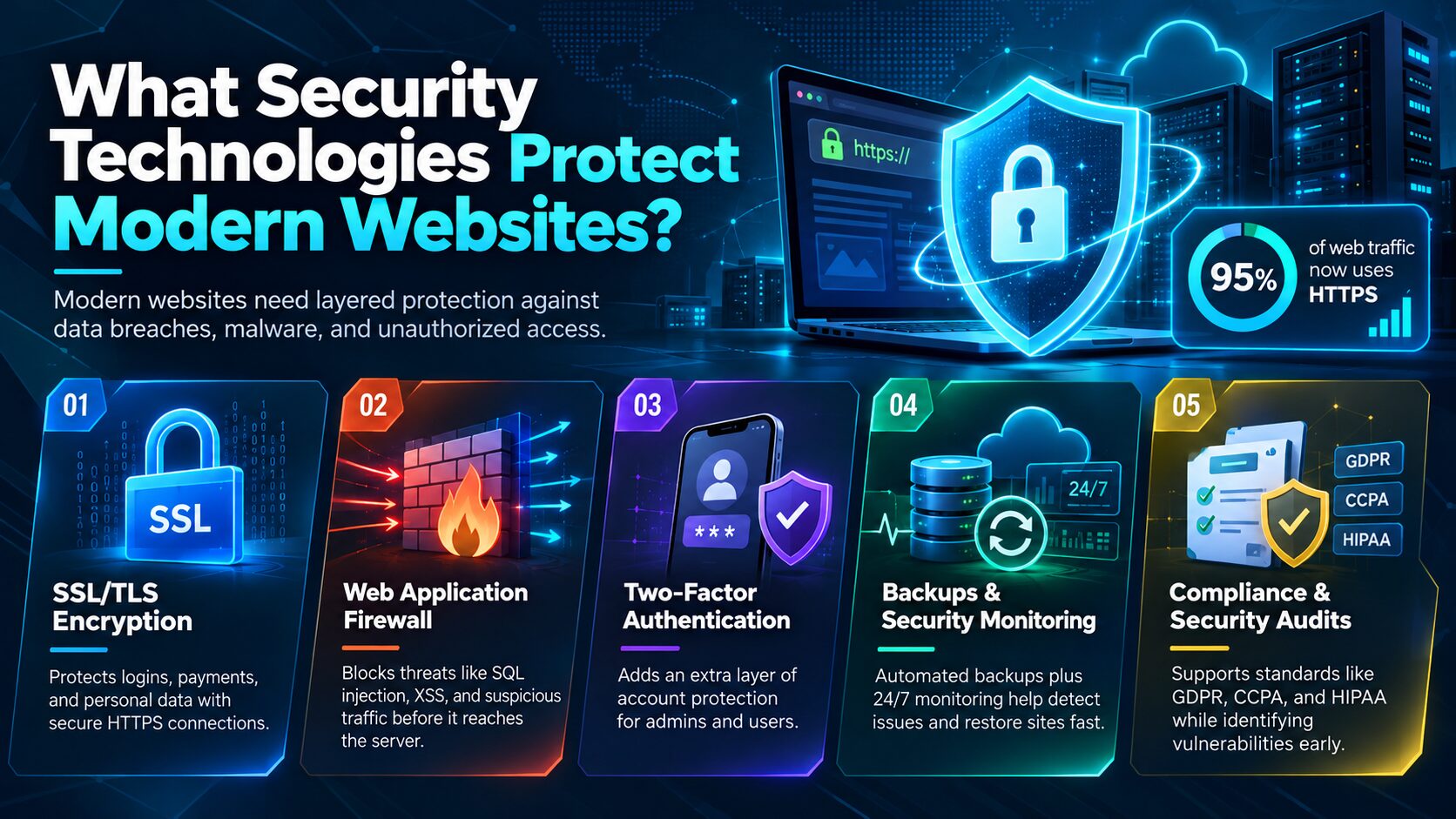
Security technologies protect websites from cyber threats including data breaches, malware infections, and unauthorized access that could compromise business operations and customer trust. SFL Media implements multi-layered security strategies including SSL encryption, Web Application Firewalls, and intrusion detection systems to safeguard South Florida business websites against evolving security threats.
SSL/TLS certificates encrypt data transmission between user browsers and web servers, protecting sensitive information including login credentials, payment details, and personal data. According to Google’s Transparency Report, 95% of web traffic now uses HTTPS encryption, making SSL certificates essential for user trust and search engine rankings.
Web Application Firewalls filter malicious traffic before it reaches web servers, blocking common attacks including SQL injection, cross-site scripting, and distributed denial-of-service attempts. CloudFlare and AWS WAF provide real-time threat intelligence and automated rule updates to counter emerging attack vectors.
Two-factor authentication adds an extra security layer for administrative access and user accounts containing sensitive information. SFL Media implements 2FA using SMS codes, authenticator apps, and hardware tokens depending on security requirements and user experience considerations for each South Florida client.
- SSL Certificate Management – Automated certificate renewal and installation across all domains and subdomains
- Web Application Firewall – Real-time traffic filtering and attack prevention with custom rule sets
- Database Security – Encrypted connections, access controls, and regular security audits
- Backup Systems – Automated daily backups with off-site storage and rapid restoration capabilities
- Access Controls – Role-based permissions and multi-factor authentication for administrative functions
- Security Monitoring – 24/7 threat detection and incident response protocols
- Compliance Tools – GDPR, CCPA, and HIPAA compliance features for regulated industries
Regular security audits and penetration testing identify vulnerabilities before they can be exploited by malicious actors. SFL Media conducts quarterly security assessments for high-value targets in South Florida’s financial and healthcare sectors.
Why Choose SFL Media for Web Development Technologies
SFL Media brings over a decade of web development expertise to South Florida businesses, combining cutting-edge technologies with proven methodologies that deliver measurable results. Our development team maintains certifications in leading technologies including AWS, Google Cloud, and Microsoft Azure while staying current with emerging trends and security best practices.
We understand South Florida’s unique business environment, from seasonal traffic fluctuations in hospitality to compliance requirements in financial services. This local expertise enables us to select optimal technology stacks that address specific challenges while positioning businesses for long-term growth and scalability.
Our agile development process includes regular client communication, iterative testing, and performance optimization throughout the project lifecycle. SFL Media delivers projects on schedule while maintaining the flexibility to adapt to changing requirements and emerging opportunities in South Florida’s dynamic market.
Post-launch support includes ongoing security updates, performance monitoring, and technology upgrades to ensure websites remain competitive and secure. We provide training and documentation enabling internal teams to manage content and basic functionality while handling complex technical requirements and strategic enhancements.
SFL Media Web Development Technologies at a Glance
| Service Component | Timeline | Team Involved | Technologies Used | Support Level |
|---|---|---|---|---|
| Technology Assessment | 1-2 weeks | Solutions Architect, Technical Lead | Performance auditing tools, compatibility testing | Strategic consultation |
| Frontend Development | 4-8 weeks | Frontend Developers, UI/UX Designer | React, Vue.js, Angular, Progressive Web Apps | Cross-browser testing |
| Backend Development | 6-10 weeks | Backend Developers, Database Architect | Node.js, Python, PHP, Cloud Infrastructure | API documentation |
| Database Implementation | 2-4 weeks | Database Administrator, Backend Developer | MySQL, PostgreSQL, MongoDB, Redis | Performance optimization |
| Security Integration | 1-3 weeks | Security Specialist, DevOps Engineer | SSL, WAF, Authentication, Monitoring | 24/7 threat monitoring |
Frequently Asked Questions About Web Development Technologies
What technologies do you use for web development?
SFL Media uses modern web development technologies including React and Vue.js for frontend development, Node.js and Python for backend services, MySQL and MongoDB for databases, and AWS and Google Cloud for hosting infrastructure. We select specific technologies based on project requirements, scalability needs, and long-term maintenance considerations for each South Florida business. Our technology stack includes security tools, performance optimization frameworks, and development tools that ensure high-quality deliverables and ongoing reliability.
Which programming languages are best for websites?
The best programming languages depend on specific website requirements, but JavaScript dominates frontend development while Node.js, Python, and PHP lead backend development for different use cases. JavaScript enables interactive user interfaces and works across all modern browsers, making it essential for contemporary web development. Python excels for data-heavy applications and machine learning integration, while PHP remains cost-effective for content management systems and established business applications common in South Florida’s diverse economy.
What is a development stack?
A development stack is a combination of programming languages, frameworks, databases, and tools that work together to build complete web applications efficiently and reliably. Popular stacks include MEAN (MongoDB, Express.js, Angular, Node.js) for JavaScript-based development and LAMP (Linux, Apache, MySQL, PHP) for traditional web applications. SFL Media selects development stacks based on project complexity, performance requirements, team expertise, and long-term maintenance needs for South Florida businesses across various industries.
How do you choose the right technology for my project?
SFL Media chooses web development technologies based on your business goals, technical requirements, budget constraints, timeline expectations, and long-term scalability needs through a comprehensive discovery process. We evaluate factors including expected traffic volume, integration requirements with existing systems, security compliance needs, and available maintenance resources. Our technology selection process includes performance benchmarking, cost analysis, and risk assessment to ensure optimal results for your specific South Florida business context and industry requirements.
What are modern web development trends in 2026?
Modern web development trends in 2026 focus on Progressive Web Apps, serverless architecture, AI integration, enhanced security protocols, and sustainable development practices that reduce environmental impact. Progressive Web Apps provide native app experiences through web browsers, while serverless computing enables automatic scaling and reduced infrastructure costs. AI integration includes chatbots, personalization engines, and automated content optimization that improve user experience and business efficiency for South Florida companies competing in digital markets.